Marketing
How Loyalty Programs Build Engagement and Boost Sales in E-Commerce - and on Service-Based Websites
Loyalty programs aren't just for major retail chains and online stores anymore. In this article, we show how to use them effectively in e-commerce and on service-based websites to boost retention, conversion, and customer value - with models, tools, inspiration, and real market case studies.

With advertising costs on the rise and user attention harder than ever to capture, e-commerce and service businesses are increasingly turning their focus toward customer retention strategies. One of the most effective tools in this space turns out to be the loyalty program - not just a way to boost sales, but also a way to build long-term relationships with customers.
While loyalty programs are mostly associated with large retail chains or online stores, their potential reaches much further. They can work just as well on service-based, expert, or educational websites, where instead of products, what's on offer is knowledge, experience, or contact. In these cases, customer loyalty doesn't mean "coming back for another purchase" - it means a willingness to interact, share data, sign up for a newsletter, or take part in an online event.
Reports and analyses available online make it clear that a loyal customer is an enormous asset for a business:
- Customer retention can be as much as 5 times cheaper than acquiring a new customer.
- Increasing the customer retention rate by 5% can translate into a 25-95% increase in profit.
- Loyal customers are more likely to recommend a brand, fueling word-of-mouth and viral marketing.
In this article, we'll show:
- What benefits loyalty programs bring to online stores (including on platforms like Shoper, WooCommerce, Shopify, and PrestaShop).
- How they can also be implemented on sites that don't sell products directly - such as the websites of training, consulting, or expert companies.
- How a loyalty program supports every stage of the marketing funnel: from acquisition, through engagement, all the way to conversion and retention.
In this article, you'll learn:
- How can a loyalty program increase sales in an online store?
- Which loyalty program model works best for your e-commerce business?
- Which e-commerce platforms make it easiest to implement a loyalty system (Shoper, WooCommerce, Shopify, PrestaShop)?
- Is it worth implementing a loyalty program on a service or corporate website (e.g., WordPress)?
- How do you design a rewards and points system for users?
- What is gamification, and how does it affect customer engagement?
- What mistakes can you make when implementing loyalty programs - and how do you avoid them?
Loyalty programs in e-commerce - benefits and models
In e-commerce, competition never sleeps - the fight for customer attention plays out not just on price or advertising, but also through experience and added value. In this context, a well-designed loyalty program becomes more than just a way to reward customers - it turns into a strategic tool for boosting profit, improving retention, and supporting marketing efforts.
Why does it pay off? Key benefits for an online store
According to an edrone report (2023), loyal customers:
- Spend about 67% more than new users.
- Are 4 times more likely to recommend a brand to friends.
- 80% of them return to a store if they feel valued by the brand (for example, through points, rewards, or personalized offers).
A loyalty program has a direct impact on:
- Increasing customer value (Customer Lifetime Value - CLV).
- Reducing acquisition costs through better retention.
- Customer segmentation - enabling precise campaign targeting.
- Higher conversion from email and SMS campaigns, especially when combined with offer personalization based on user activity.
How does a loyalty program support the marketing funnel?
Loyalty programs don't operate in a vacuum - their effectiveness grows when they're tied to the marketing funnel:
| Funnel stage | Example loyalty actions |
| TOFU - Acquisition | Points for registering, signing up for the newsletter, referring a friend |
| MOFU - Engagement | Points for reviews, wishlists, quiz participation, loyalty emails |
| BOFU - Conversion | Discounts for points, bonuses for returning customers, exclusive VIP offers |
| Post-sale - Retention | Referral programs, double points on future purchases, premium subscriptions |
This shows the power of a loyalty program - by delivering added value to customers and looking after them, you motivate them to come back and strengthen a relationship with your brand that's built on real value.
Types of loyalty programs in e-commerce
There's no single model for loyalty programs - stores choose solutions suited to their industry, margins, and customer profile. The most common types are:
- Points-based (reward points)
- For example, 1 point for every $2 spent.
- Customers can exchange points for discounts or products.
- Progressive (tier-based)
- Customers earn tiers (e.g., silver, gold, platinum) with increasing benefits.
- Creates motivation and a sense of exclusivity.
- Subscription-based
- Loyalty programs structured as a paid subscription (e.g., free shipping, early access, VIP discounts).
- Referral programs
- Rewards for referring a friend (e.g., a discount for both parties).
- Exclusive loyalty perks
- Access to limited collections, early sales, personalized offers.
- Integrated with reviews and UGC (User Generated Content)
- Points for a product review, an Instagram photo tagging the brand, and so on. UGC is also very SEO-friendly when it's featured on the store's site.
🎯 Loyalty isn't a cost - it's an investment. If you can retain a customer, you don't have to keep paying to acquire them over and over. And once a customer comes back on their own, that's when the real profit begins.

Loyalty program integrations across e-commerce platforms
Implementing a loyalty program is easier today than ever - most e-commerce platforms offer ready-made modules or simple integrations:
Shoper - loyalty program
Shoper offers a built-in loyalty program module, available on its higher-tier subscription plans. It lets you award points for purchases and let customers exchange them for discounts, all easily configurable from the admin panel.
Shoper's loyalty program integrates with newsletter systems and remarketing campaigns - so you can, for example, send emails reminding customers about their available points or launch ad campaigns aimed specifically at loyal customers. It's a ready-made solution for companies looking for a quick start without having to build out an elaborate system.
WooCommerce (WordPress) - loyalty program
WooCommerce is the most flexible platform - it offers huge possibilities thanks to the WordPress CMS's wide plugin ecosystem. Some extensions that add loyalty program features include:
- WooCommerce Points and Rewards - a classic points-for-purchases system.
- myCred - advanced gamification with the ability to earn points for various actions (e.g., logging in, commenting, taking part in quizzes).
- YITH WooCommerce Points and Rewards - a simple, intuitive rewards system to configure.
Thanks to WordPress's open architecture, a loyalty program can easily be integrated with additional features, such as online courses, communities, newsletters, or email marketing automation.
This is an ideal solution for companies that want to tailor the program to their own business model - for example, rewarding not just purchases, but also activity on the site.
Shopify
Shopify has a very well-developed ecosystem of loyalty apps that can be implemented without any coding. Here are some example loyalty program apps:
- Smile.io - lets you build points-based, VIP, referral, and badge programs.
- LoyaltyLion - extensive customer segmentation options and marketing automation integrations.
- Yotpo Loyalty & Rewards - integrated with a reviews and ratings system, which boosts customer engagement.
Shopify also allows seamless integration of loyalty programs with marketing and communication tools - including Klaviyo and GetResponse - which makes it possible to run automated campaigns that motivate customers to take action.
PrestaShop
PrestaShop also offers dedicated loyalty modules, including:
- PrestaShop Loyalty - the official module for awarding points and letting customers redeem them.
- Knowband Loyalty Points - a third-party solution, but more feature-rich, with extras like points reminders and configurable reward thresholds.
These modules typically offer integrations with newsletter systems and CRMs, letting you target individual offers to active customers and use loyalty data to segment ad campaigns.
Loyalty programs on service-based websites - how to encourage contact and build relationships without a store
A loyalty program on a site that doesn't sell physical products might sound like a contradiction. Nothing could be further from the truth. For service, expert, or educational businesses, user loyalty means their engagement, their willingness to come back, their trust, and ultimately, their conversion into a customer. In this context, points or rewards are a tool for rewarding attention and interaction, not just purchases.
How is loyalty different in services?
- The customer doesn't "buy" right away - they usually read, sign up, and follow along first.
- Points or rewards motivate further interaction: sign-ups, clicks, event participation.
- The goal isn't a sale in a cart, but getting a quality lead or point of contact.
Example: a loyalty program at a training company
Here's what an extensive loyalty program for a service-based website might look like, and how a user journey might unfold - from interest, through engagement, to a sale.
Goal: Attract and activate a potential customer who will later sign up for a training course.
An example user journey:
- A user lands on the blog and reads an article titled "How to Communicate Better as a Team."
- The article contains a lead magnet - "Sign up for our newsletter and download the e-book '10 Team Communication Mistakes.'"
- After signing up, they receive starter points (e.g., 100 points) and access to the PDF.
- Every week they receive a newsletter with valuable content - earning extra points for every open or click. The newsletter can also be used to collect leads for webinars, or even in-person events.
- Once they've collected 500 points, the user can claim:
- a 10% discount on training,
- access to an exclusive, high-value webinar,
- a 1:1 consultation,
- additional premium material.
- The user needs to be kept informed - communicating the benefits they've accumulated can encourage them to engage further or to make an additional purchase.
What actions can you reward?
| Action | Example | Benefit |
| Newsletter sign-up | +100 pts | Starts the lead journey |
| Webinar participation | +150 pts | Greater engagement |
| Completing a survey | +100 pts | Data on customer needs |
| Opening the newsletter | +10 pts | Recipient activation |
| Sharing an article | +50 pts | Organic reach |
| Commenting on the blog | +30 pts | Community building |
| Referring a friend | +200 pts | New lead acquisition |
The psychology of engagement: why do loyalty programs work?
- The reciprocity principle - a user who has "received" something (like an e-book) is more willing to give something back (time, trust, money).
- The sunk-cost effect - once someone has already earned points and badges, they're more likely to dig deeper into the offer.
- Gamification - badges, levels, goals - these work like mini-games, boosting satisfaction while also creating FOMO.
- Community - if a site highlights other users' activity (e.g., a leaderboard), it reinforces the feeling that "everyone's here."
🎯 You don't need to sell anything to build loyalty. If a customer keeps coming back for your knowledge, experience, or inspiration, a relationship has already formed - and sooner or later, it will lead to a conversion.
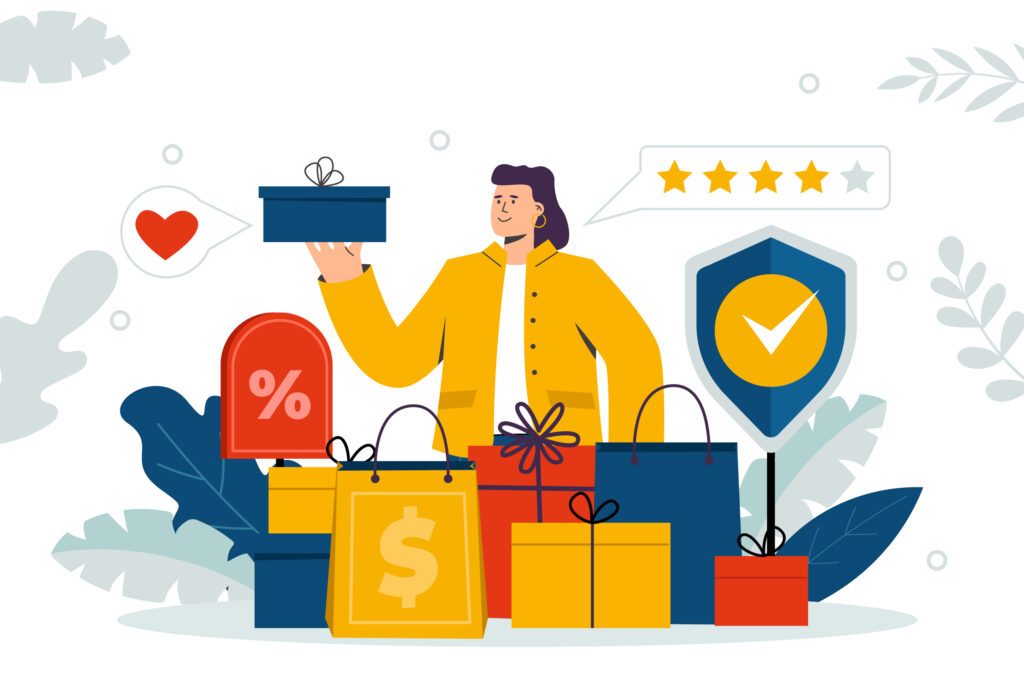
Gamification as a loyalty engine - engage users like it's a game!
Gamification means applying mechanisms borrowed from games (points, levels, badges, leaderboards, missions) in a context unrelated to seasons or entertainment - such as shopping, using a service, or education. More and more e-commerce and service businesses are turning to these tools to motivate users to come back and take action, rather than just passively consuming content. You may already recognize gamification from Temu, AliExpress, or Shein - these mechanisms are used very heavily there.
Why does it work?
- Micro-rewards - every small action (a click, a poll response, a review) gets rewarded instantly.
- Intrinsic motivation - the user isn't acting "for the discount," but out of curiosity, or for status, a goal, or prestige.
- Competition and progress elements - visible levels, a points counter, leaderboards of active users.
- FOMO and collecting - badges that can only be earned once, or within a limited time.
What gamification elements can you implement?
| Mechanism | How it works | Example |
| Points | For purchases, actions, participation | 1 pt per $2 / 20 pts for a review |
| Tiers | Access to bigger benefits | Bronze, Silver, Gold - each with its own bonuses |
| Badges | For specific activities | "Reviewer of the Month," "Webinar Expert" |
| Missions/tasks | A series of tasks to complete | "Sign up for the newsletter, join a webinar, comment on an article" |
| User leaderboard | Community and competition | Top 10 most active users of the month |
| Random rewards | The surprise factor | A daily spin-to-win or a quiz |
What can you gain from implementing gamification?
- An increase in average time spent on the site (dwell time).
- Better user retention and a lower churn rate (the rate at which users leave or drop off).
- More returning sessions and more actions per user.
- Building a community around your brand, rather than just a transactional relationship.
🎯 Gamification won't replace the quality of your offer, but it can act as a "booster" for your loyalty program. If a user comes back out of curiosity and a sense of progress, you have their attention - and today, that's a premium currency.
The most common mistakes when implementing a loyalty program - and how to avoid them?
A loyalty program can be a powerful tool, but only when it's well designed and consistently implemented. Many companies make the same mistakes - often small ones on the surface - that undermine the effectiveness of the whole system. Here's a list of the most common problems and how to prevent them:
Low visibility for the loyalty program
The problem: Users don't know the program exists, or they don't understand how it works.
How to avoid it:
- Add banners about the program on the homepage, in the cart, and in the customer account panel.
- Send emails letting customers know about points they've earned.
- Create a dedicated page with a simple set of rules and a description of the benefits.
- Remind customers about redeeming points at checkout.
Overly complicated rules for the loyalty program
The problem: The program has too many conditions, exceptions, and conversion rates - so users give up on using it.
How to avoid it:
- Use a simple conversion rate (e.g., 10 points = $1).
- Avoid too many tiers or customer classes at the start.
- Communicate the program in terms of benefits, not rules (but don't skip the terms and conditions!).
A loyalty program is meant to bring value to the customer - and that's exactly how you gain value from it too. The more convoluted the program, the more you end up hiding that value.
Low-value rewards
The problem: The customer uses the loyalty program but doesn't feel like they're gaining anything from it. As a result, they lose interest and disengage.
How to avoid it:
- Offer valuable rewards even at low point thresholds.
- For non-product sites, offer things like an e-book, a service discount, or webinar access.
- In e-commerce, free shipping, a small gift, a sample product, or a coupon all work great. Perfume stores are a great example - they often include free samples with an order.
- Test what actually interests your target audience.
No integration with other marketing channels
The problem: The program runs "alongside" everything else - it's not synced with emails, campaigns, or social media.
How to avoid it:
- Connect the program to your newsletter - for example, "Earn points just for opening this email!"
- In remarketing campaigns, target your loyal customers specifically.
- Use points as a CTA in ads: "Sign up and get 100 points."
The program as an "add-on," not a strategy
The problem: A loyalty program launched without much thought - "because everyone else has one."
How to avoid it:
- Define a concrete business goal: more sales, more leads, more returning users.
- Measure results - for example, LTV, purchase frequency, email open rates.
- Tailor the program's mechanics to your industry and sales model.
Summary
With competition on the rise, user attention in short supply, and ad campaigns growing more expensive, customer loyalty is becoming the most valuable currency in e-commerce and digital services. Loyalty programs - well designed, integrated with the marketing funnel, and tailored to your business model - can not only boost sales, but above all, build lasting relationships with customers.
Whether you:
- run an online store on Shoper, WooCommerce, or Shopify,
- manage a service-based website or a training company built on WordPress,
it's worth seeing loyalty not as an "add-on," but as a strategic element that:
- encourages people to come back,
- boosts engagement,
- raises the value of every user you acquire,
- turns followers into customers - and customers into brand ambassadors.
Ready to implement a loyalty program?
Whether you need a simple points system or an elaborate gamification setup integrated with a CRM, a loyalty program can be exactly what your business needs to boost retention and conversion.
Get in touch with us if you'd like to:
- find out what benefits a loyalty program could bring to your industry,
- choose the right tools,
- plan out the implementation of your loyalty program step by step.