Marketing
First Half of 2025 in E-Business: Trends, Changes, and Declines
What did Polish business look like in the first half of 2025? We look at the dynamic growth of e-commerce, new regulations, shifting consumer behavior, and the challenges facing brands - and what to expect next.
The first six months of 2025 brought a series of significant changes and trends in Polish e-business - particularly in the e-commerce, services, and B2B sectors. Rapid growth in online sales, the rising importance of marketplaces, new regulations (including the Polish Accessibility Act), and shifting consumer expectations are all reshaping how companies operate today. In this part of our summary, we look at what happened in e-business over the first half of the year.
E-commerce: records, consolidation, and new opportunities
A record share of online sales
The start of 2025 brought impressive results for Polish e-commerce. As early as January, online trade - online stores and marketplace platforms - reached a 9.1% share of total retail sales, the highest figure in five years. In value terms, online sales reached 6.94 billion zloty, a 9.4% year-on-year increase. Grocery purchases made online grew especially fast - up 43.6% compared to the same period a year earlier.
E-commerce in Poland and abroad
On a global scale, Poland is starting to matter as a serious player. The country climbed to 19th place worldwide in terms of e-commerce market value. According to data for the first quarter of 2025, the number of online orders in Poland grew 24% year on year - one of the highest growth rates in the world. What's more, as much as 29% of Polish e-commerce companies' revenue now comes from foreign customers - mainly from Germany, France, and the Czech Republic. The products that most often go abroad are clothing, automotive parts, and cosmetics.
Marketplaces: dominance and a shifting balance of power
New leaders and market moves
In 2025 we're seeing further consolidation of the e-commerce market around large platforms. Allegro holds on to its position as leader, but the biggest surprise is the meteoric rise of China's Temu, which has become the second-largest marketplace in Poland, overtaking even Amazon and AliExpress. Meanwhile, MediaMarkt launched its own marketplace with an offer for businesses, integrated with its offline channels and with room to expand across the EU.
Allegro is also widening its range - in 2025 it enabled the sale of alcohol, introducing an age and sobriety verification system at pickup. These moves show that the giants are looking for new sources of growth and ways to diversify their offering.
Temu's explosive growth and its consequences
The Chinese platform Temu started 2025 with a bang - thanks to an aggressive pricing strategy and "low-cost and gamification" promotions, it rocketed to become the second-largest marketplace in Poland, overtaking Amazon and AliExpress, among others. However, a report from Poland's Office of Competition and Consumer Protection (UOKiK) warned against "mystery promotion" practices - including misleading claims about very low prices that don't always match the actual price from 30 days earlier.
Low prices and gambling-like elements (a wheel of fortune, referral bonuses) grab attention, but they also raise doubts about product quality. With goods often labeled simply as "Chinese," users tend to treat these purchases more as entertainment than as deliberate shopping.
Amazon responds: Amazon Haul
Amazon didn't stay indifferent to Temu's success and launched its own answer in Europe and the US - Amazon Haul. It's an in-app store offering cheap products (under $10-20), shipped directly from China, with slower delivery (roughly one to two weeks). Early tests, however, show that:
- the product selection is limited and repetitive,
- it lacks the gamification and referral promotions that drew users to Temu,
- Haul deliveries are faster, but prices are often higher than on Temu.
Will Amazon's experiment pay off? Time will tell. Amazon Haul has not yet launched on the Polish market.
An echo of history: Shopee - a fast start, a sudden retreat
Shopee followed a similar path earlier - after an equally dynamic rollout of a low-cost marketplace model aimed at younger consumers, the platform unexpectedly pulled out of Poland within little more than a year. Regulatory problems, a lack of a transparent local strategy, technical issues, and poor alignment with local consumer preferences led to stagnation despite the initial hype. Shopee's story is a warning: fast success can turn out to be very fragile if it isn't backed by quality, trust, and adaptation to the local market.
Market consolidation
For smaller online stores, the situation is becoming increasingly difficult. Price wars, high operating costs, rising customer expectations, and new regulations mean many of them are struggling with low profitability. The Omnibus Directive, which requires showing the lowest price from the 30 days before a promotion, has curbed the use of fake discounts, changing the dynamics of sales campaigns. On top of that, many large retail chains (e.g., Castorama) are launching their own sales platforms - the "platformization" of retail is becoming a fact of life.
New regulations and standards
The Polish Accessibility Act
A key regulatory change that took effect on June 28, 2025, is the implementation of the Polish Accessibility Act - Poland's domestic implementation of the European Accessibility Act. The new rules require digital products and services - including websites, online stores, payment terminals, ATMs, and ticket machines - to be accessible to people with various types of disabilities. Depending on the store, this can mean significant changes to how it's built or how offers are presented.
Although microenterprises are formally exempt from these obligations, many are already investing in accessibility improvements, treating it as part of becoming more professional and as a chance to reach new customer groups.
Read more about the Polish Accessibility Act here.
The Omnibus Directive and the DSA
Earlier regulations - such as the Omnibus Directive and the Digital Services Act (DSA) - are starting to have a real impact on how e-commerce operates. The requirement for transparent promotional pricing and new content-moderation rules for digital platforms are just part of the changes that demand greater vigilance and better compliance processes from companies.
Consumer behavior: caution, mobility, omnichannel, and new expectations
Polish shoppers' spending caution
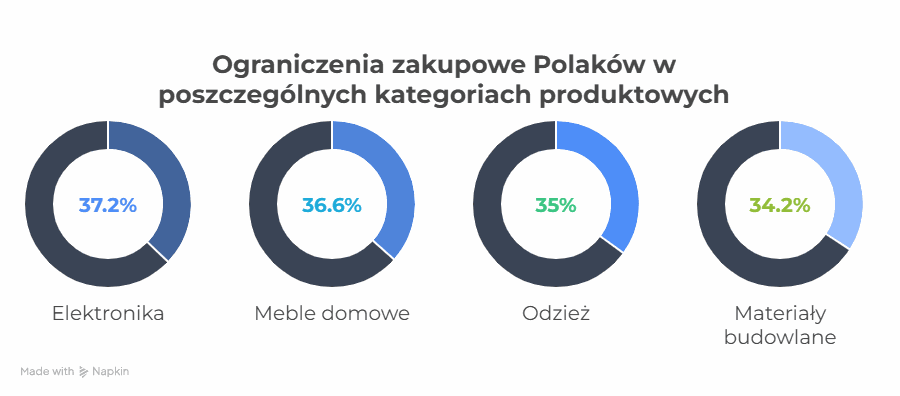
In the first half of 2025, Poles showed particular caution when it came to spending on pricier categories. According to a report by UCE Research and Shopfully, 37.2% cut back on electronics spending, and as many as 36.6% became more cautious about buying home furniture. 35% of respondents admitted to cutting back on clothing purchases, and 34.2% did the same for investment-type categories such as building materials or tools.
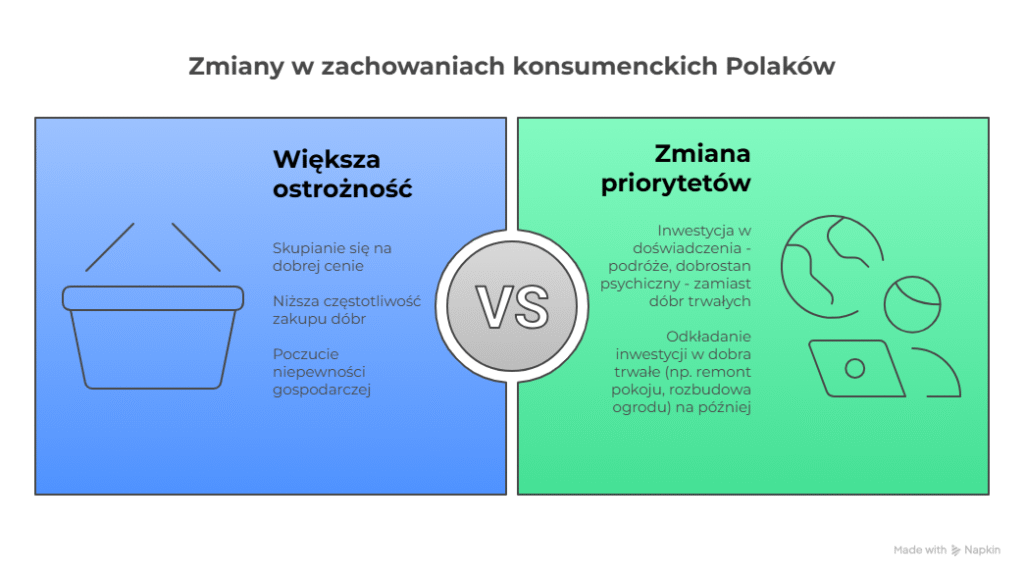
For Poles, what matters most now is unit price, lower purchase frequency, and, ultimately, a sense of economic uncertainty. Consumers would rather wait for a good-quality product, and turn to outlet or used goods instead of buying new items on impulse. An interesting shift is also visible in priorities - instead of durable goods, Poles are increasingly investing in experiences (travel, mental health), which is also curbing spending in those categories.
Mobile-first shopping and apps
The smartphone has become the primary shopping tool for Poles. As many as 65% of internet users now shop via phone, and 39% complete transactions on mobile - more than on laptop. Shopping apps from the biggest retail chains, such as Biedronka, Lidl, and Żabka, are among the most downloaded and used - they offer real added value for customers of these chains, including discounts, promotions, and loyalty programs. The e-grocery sector (buying food and everyday items online) is also growing fast - its value is expected to reach as much as 14 billion zloty by 2028.
New delivery and payment standards
Among consumers, express deliveries, parcel lockers (chosen by 66% of customers), and convenient mobile payments are all growing in popularity. BLIK remains the leading online payment method (38% share), and deferred payments (BNPL - buy now, pay later, such as Klarna) are now widely accepted by younger generations. Research shows that as many as 93% of customers will abandon a purchase if a store doesn't offer their preferred payment method.
Omnichannel as a baseline expectation
Customers today expect full consistency in their shopping experience - both online and offline. 71% of consumers say they buy the same brands across both channels. Click and collect, the ability to return items in a physical store, and being able to see a product "in person" before finalizing an online purchase - these are all factors that decide which brand they choose.
What did the first half of the year bring for business?
The first half of 2025 showed that Polish business, and the e-commerce sector in particular, is maturing and consolidating. On one hand, we're seeing dynamic growth - especially in mobile and cross-border shopping. On the other, there's clear cost pressure, rising customer expectations, and a growing importance placed on regulation and social responsibility.
Companies that want to stay competitive need to invest in technology, digital accessibility, data analytics, and a presence across multiple sales channels. The key will be flexibility, a readiness to work with platforms, and the ability to adapt quickly in an environment that never stops changing.
In the next part of our summary, we'll look at what changed in marketing: from the impact of AI, through new challenges in SEO and social media, to the transformation of the data model in the post-cookie era.
Sources used:
- Poland's GDP in 2025: GUS Published New Data - Business Insider
- 2024 Summary and 2025 Forecasts: E-commerce (Part 1) - AboutMarketing.pl
- E-commerce Picks Up Speed at the Start of 2025! - Polish Chamber of Commerce
- European E-commerce Gains Momentum: Poland and Germany Among the Leaders in Online Order Growth in Q1 2025 - Ecommercenews.pl
- "Omni-commerce. Shopping Made Easy" - Polish E-commerce in 2025 - Socialpress
- Monthly Summary [May 2025] - E-commerce w Praktyce
- The Polish Accessibility Act - What Do the New Regulations Mean? - Office of the SME Ombudsman
- Changes in SEO After Google I/O 2025 - What You Need to Know - OBTK
- 2025 Marketing Trends - Opinions From 23 Industry Experts - SprawnyMarketing.pl
- Cookies Are Passé! What's Next in E-commerce Analytics When the Crumbs Run Out - E-commerce w Praktyce
Have questions about how to adapt your business or online store to these new trends?
Get in touch with us - we'll advise you on how to strengthen your position, help you implement the changes, and plan a strategy together. Click below or fill out the form: