Marketing
Marketplaces Built on Mirakl: Scaling Into New Sales Channels More Easily
Marketplaces have become one of the most important sales channels in e-commerce, and many of them run on the same underlying technology: Mirakl. Find out what this platform is and why it makes it significantly easier for sellers to expand into new marketplaces and scale their sales.
Selling on marketplaces has become one of the most important growth channels in e-commerce. More and more companies sell their products not just through their own online store, but also on sales platforms run by large retail brands.
One of the technological foundations behind many of these platforms is Mirakl. While it's an invisible layer of technology to end customers, for sellers it can mean a much easier expansion into other marketplaces that run on the same platform.
In this article, we explain what Mirakl is, why more and more marketplaces are using it, and how it can make it easier to scale your sales.
Don't want to read the whole article? Check out the episode of our Sixteractive podcast on this topic:
What is Mirakl?
Mirakl is a technology platform that allows companies to build and manage marketplaces. Instead of developing an entire infrastructure from scratch, retailers can use a ready-made solution designed specifically for the marketplace sales model.
The platform handles, among other things:
- seller management,
- the product catalog and listings,
- orders and order handling,
- integrations with external systems,
- marketplace settlements and commissions.
This lets companies launch their own marketplace relatively quickly and invite third-party sellers to sell products on their platform.
To the end customer, it looks like an ordinary online store belonging to a given brand. In reality, though, some of the products may come from third-party sellers operating within that marketplace.
Mirakl is used by many companies – in Poland, these include Empik, Decathlon, Black Red White, and Carrefour, among others.
Why are more and more companies launching marketplaces?
The marketplace model is gaining huge popularity among large retailers and e-commerce platforms. The reason is simple – it lets you significantly expand your offering without having to warehouse every product yourself. Empik's online store is a good example. Instead of selling only its own range, the company opens up its platform to other sellers and takes a commission on their sales.
The benefits are significant:
- expanding the product catalog several times over,
- increasing traffic on the platform,
- a new revenue stream from commissions,
- the ability to move quickly into new product categories.
Mirakl makes it easier to implement this kind of business model, which is why more and more large brands are choosing to launch their marketplace on this particular technology.
What does Mirakl mean for sellers?
From a seller's perspective, the biggest advantage of Mirakl is a certain level of standardization.
Marketplaces built on this technology share similar mechanics, similar data structures, and similar ways of managing products and orders.
As a result, many processes look very similar across different platforms.
In practice, this means that once a company has integrated its sales system with one Mirakl marketplace, entering the next one can be much simpler than doing the same with an entirely different technology.
Some of the integration work and processes can be reused, which significantly cuts down implementation time.
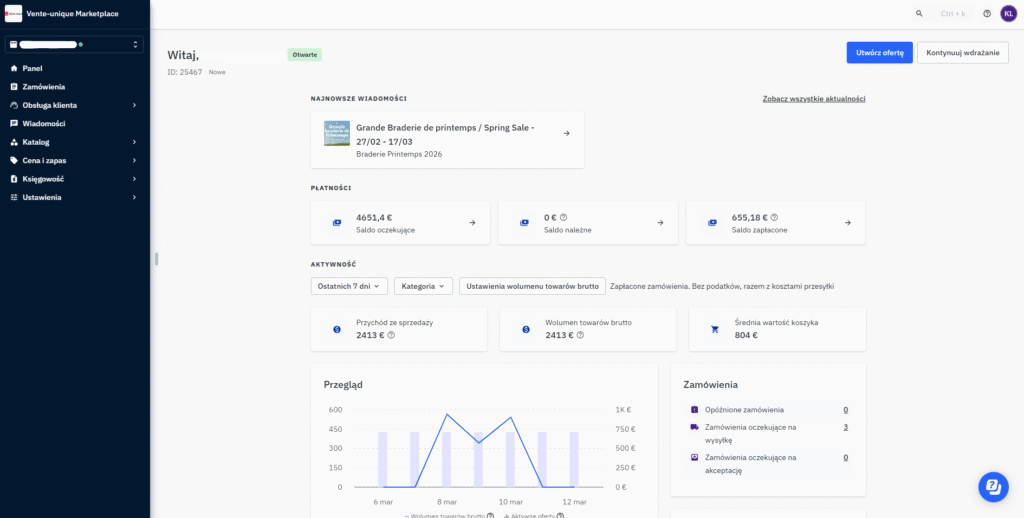
What does selling on Mirakl marketplaces look like?
While every marketplace has its own rules and requirements, the general sales process usually looks fairly similar.
1. Seller registration
The company sets up a seller account on the chosen marketplace. At this stage, verification of company data and acceptance of the terms of cooperation are usually required.
2. Adding products
Products can be added manually in the seller panel, or through integration with the store's system, a PIM, or an ERP.
In many cases, the marketplace also provides ready-made product catalogs that sellers can attach their listings to.
3. Managing listings
The seller manages prices, product availability, and listing details. They can also take part in promotions organized by the marketplace.
4. Order handling
Orders land in the Mirakl panel and can be handled manually or automatically through integration with the store's system.
5. Settlements
The marketplace takes a commission on sales, and the remaining amount goes to the seller according to the settlement schedule.
Why does Mirakl make it easier to scale sales?
The biggest challenge when expanding into marketplaces is usually technological integration. Every platform can have a different API, different data formats, and different order-handling processes.
For marketplaces built on Mirakl, the situation looks much better.
Thanks to the shared technology, many elements stay similar:
- the product catalog structure,
- how listings are managed,
- order handling,
- API integration.
This means that once the first integration is done, subsequent rollouts can be significantly simpler and faster.
For companies growing a multichannel sales strategy, this is a major advantage, especially if they plan to be present on multiple marketplaces.
When is it worth considering selling on Mirakl marketplaces?
Selling on Mirakl-based platforms can be especially attractive for companies that:
- want to expand sales into new channels,
- are building an omnichannel strategy,
- have a broad product catalog,
- are planning to expand into new markets.
With a growing number of marketplaces using this technology, Mirakl is becoming an interesting sales network to plug into.
Summary
Mirakl isn't a marketplace in itself – it's a technology that lets companies build their own marketplace platforms. For sellers, though, that means something very important: greater consistency across different sales channels.
If a company is already integrated with one Mirakl marketplace, entering other platforms built on the same technology can be significantly simpler.
In a world of e-commerce where speed of expansion and channel diversification play a key role, this kind of technological advantage can make a real difference in scaling a business.
If you're planning to move into e-commerce, want to start attracting customers online, or need support putting your first steps in order, get in touch with us. We'll help you plan actions that fit your business, your budget, and your actual goals, rather than marketing promises.
A good starting strategy isn't about speeding everything up – it's about doing the right things in the right order.
Click below or fill in the form: