Marketing
KSeF: What You Need to Know and How to Prepare Properly
From 2026, every Polish company will be required to use the National e-Invoice System (KSeF). It's a genuine overhaul of invoicing – the end of PDFs and paper, and the start of mandatory e-invoices in a single XML format. Many business owners are asking how KSeF works, who it applies to, and how to prepare to avoid chaos. This guide covers everything you need to know: deadlines, rules, emergency procedures, and a practical step-by-step rollout plan.
The National e-Invoice System, or KSeF for short, is the Polish Ministry of Finance's central platform for issuing, receiving, and storing so-called structured invoices. In practice, this means the invoice document, which today takes the form of paper or a PDF file, will be replaced by a digital file with a uniform structure. Every invoice will have to pass through the system and receive a unique KSeF number before it can be considered issued.
This spells the final phase-out of paper invoices and so-called "receipt books." The reasons behind this change are both fiscal and organizational. The state has for years been looking for ways to close loopholes in the tax system and fight VAT fraud. Thanks to KSeF, the tax administration will have immediate visibility into issued invoices – not only during an audit or when filing SAF-T reports, but in real time. From a business owner's point of view, however, the other side of the coin matters just as much: streamlining and automating accounting processes. Companies will no longer need to keep binders full of documents, since archiving will happen automatically within the state system. On top of that, integrating accounting systems with KSeF is meant to speed up document flow and reduce the risk of errors.
Still, there's no denying that for many business owners this will be a genuine overhaul, comparable to the introduction of mandatory fiscal cash registers or SAF-T files (JPK). KSeF brings sweeping change – it requires adapting IT systems and internal procedures, and preparing employees. It often comes with extra costs for the company. But whoever starts preparing early enough can treat KSeF as an opportunity, while whoever waits until the last moment will be putting out fires in their accounting department in 2026.
Key deadlines and obligations under KSeF - 2025, 2026, 2027
KSeF won't be rolled out for everyone at once – the obligation will be phased in. What matters, though, is that regardless of the date from which you'll be required to issue invoices in KSeF, from 1 February 2026 you must be ready to receive them!
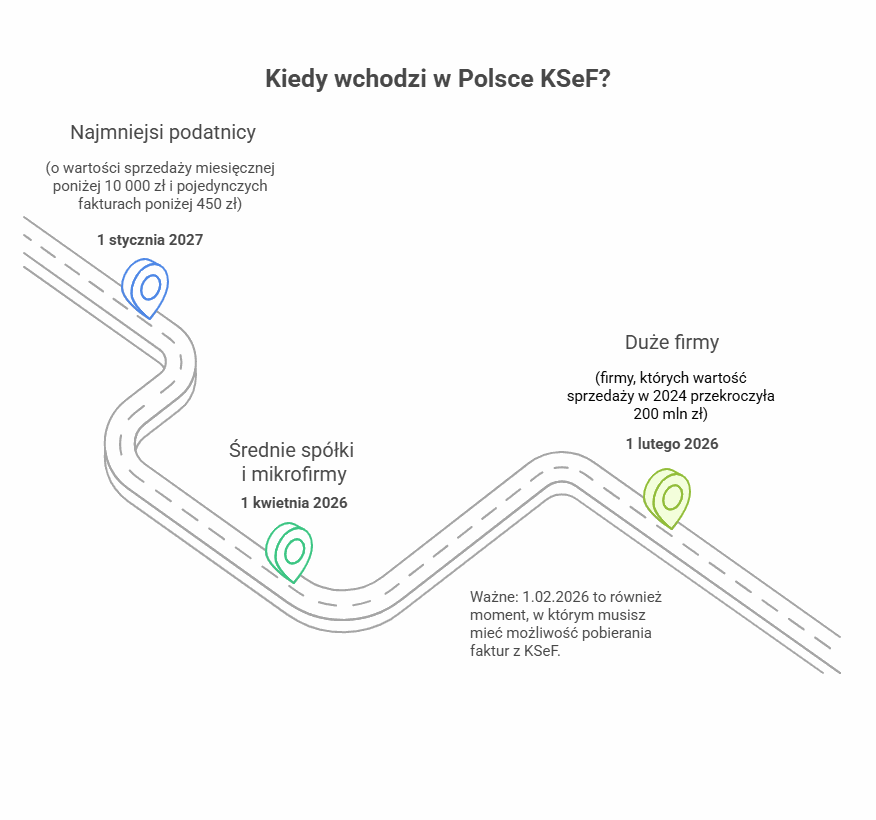
From 1 February 2026, the system becomes mandatory for large companies whose sales value in 2024 exceeded PLN 200 million. These largest entities, operating at a national and international scale, will be the first group required to use the new system in full.
Then, from 1 April 2026, the obligation will extend to all remaining businesses – from micro-businesses to medium-sized companies.
Only in the third stage, from 1 January 2027, will the obligation extend to the so-called smallest digitally excluded taxpayers – businesses whose individual invoices don't exceed PLN 450 and whose total monthly sales are below PLN 10,000.
It's worth remembering that not all documents will need to be entered into the system right away. Excluded from the obligation for now are, among others, VAT RR invoices (i.e., purchase documents from flat-rate farmers), which can only start being issued in KSeF from April 2026. An exception also applies to invoices for consumers – KSeF mandatorily covers B2B and export transactions, while sales documents for individuals not running a business remain outside the system.
Although businesses were hoping for a classic transition period, during which the current solutions and KSeF could be used side by side, the Ministry of Finance has announced a different approach. From the very first day the rules apply, the only acceptable form of a B2B invoice will be a KSeF invoice. The only concession offered by the Ministry of Finance is that no penalties will be imposed for invoicing errors until the end of 2026. This means a business won't be able to avoid the obligation to use the system, but if a mistake happens in the first few months, it won't face immediate financial consequences.
How does KSeF work on a technical level?
The FA(3) structure
Every invoice issued in the system takes the form of an XML file (Extensible Markup Language) that follows the FA(3) logical structure (schema). This is a structured document, meaning one in which every element – counterparty data, line items, net and gross amounts, VAT rates – sits in a strictly defined field. This lets accounting systems read them automatically, while the Ministry of Finance can be sure the data is complete and consistent.
For businesses, this means the end of any freedom in how an invoice looks. There's no more room for custom graphic templates or specific table layouts – what matters is compliance with the format. Of course, nothing stops a company from also generating an attractive-looking PDF for the counterparty, but the binding document will always be the XML version from KSeF.
API and integration
The system runs on a programming interface called an API. Think of it as the language accounting software uses to talk to KSeF. The process works like this: the user issues an invoice in their system, that system packages the data into an XML file and sends it through the API to KSeF, and KSeF assigns the invoice a unique number. Without that number, the invoice does not legally exist.
For companies, this means having to adapt their current accounting software. If the software doesn't support FA(3) or lacks KSeF integration, it will need to be updated or replaced. This could turn out to be the most expensive part of the rollout – especially for companies running old ERP systems that haven't been updated in years.
Authorization and certificates
Access to KSeF isn't open to everyone – every company must authenticate itself. Currently available methods include a qualified electronic signature, a qualified electronic seal, a Trusted Profile (Profil Zaufany), and a token generated within the system. Tokens will keep working until the end of 2026, but from 2027 they'll be replaced by a new login method – the KSeF certificate. The first applications for certificates can be submitted starting in November 2025. The issuer's certificate is especially important for offline work, since it's the only way to issue invoices outside the system (e.g. in offline24 mode or during an outage), before sending them on to KSeF along with the relevant QR codes.
Permissions to use KSeF can be granted in two ways: through the ZAW-FA form in the e-Tax Office (e-Urząd Skarbowy), or directly within the system itself. In practice, it's recommended that access be granted to at least two users – that way, one person's absence won't bring the entire invoicing process to a halt.
How to send invoices to KSeF? Invoicing models
The Ministry has provided for several models of sending invoices, which can be matched to the specifics of a given business.
The automatic model is the most convenient and secure option. Once an invoice is issued in the accounting system, it goes straight to KSeF, and the business owner doesn't need to remember any extra steps. It's also a way to minimize the risk of errors, since system integration handles things in the background.
The manual model assumes the user uploads invoices to KSeF themselves through the Ministry of Finance's portal. In practice, this means extra work and time – it tends to suit small businesses that issue only a handful of invoices a month. In this model, the invoice issue date becomes the moment the document is uploaded to the system.
The batch model allows several invoices to be uploaded at once. Each of them receives the same issue date. This solution suits companies that generate a lot of documents at the same time, for example as part of a single sales campaign or a monthly subscription billing run.
KSeF 2.0 – what's new from 2026
The version of KSeF launching in 2026 is already being called KSeF 2.0 – enriched with additional features that respond to businesses' requests.
The most important new feature is offline24 mode. It allows an invoice to be issued when there's no internet access or the Ministry of Finance's system is undergoing technical downtime. Such an invoice carries two QR codes – one marked "OFFLINE," the other with the certificate signature. The document must be sent on to KSeF no later than the next business day, but the issue date remains the one shown on the invoice.
The second new feature is invoices with attachments. Until now, all information had to be entered into the XML schema, which could be problematic for long specifications or detailed industry-specific data. In KSeF 2.0, it will be possible to add an attachment file, also in structured form, which will make life easier for trading and manufacturing companies.
The third change is the KSeF mobile app. With it, invoices can be issued, viewed, and shared straight from a smartphone. This is a major convenience for micro-entrepreneurs and freelancers, who don't always work at a computer.
Another innovation is the partial opening of KSeF to B2C transactions. A taxpayer will be able to issue an invoice for a consumer through the system if the customer requests one. In practice, this means B2C is still not covered by the obligation, but businesses will gain the option of full digitization if they want it.
Finally, it's worth mentioning the changes to correction invoices. Until now, businesses had to have proof that the counterparty had received the correcting invoice. Under KSeF, the system itself will take over that confirmation role – since the invoice sits in the database, it's considered delivered. This is a significant simplification and the end of emailing back and forth to request delivery confirmations.
KSeF emergency procedures – what to do when something goes wrong
KSeF is an IT system, so it's reasonable to assume that from time to time something won't work. That's why every company should have emergency procedures ready.
If the internet goes down, the business owner issues the invoice in offline24 mode. The document gets QR markings and is valid, but must be sent on to KSeF the next business day.
In the case of a KSeF system outage officially announced by the Ministry of Finance, invoices are also issued offline. The difference is that once the system is restored, the taxpayer has up to seven days to send the documents on. This is a safeguard against economic disruption.
If an invoice is rejected by the system, the user gets an error message. This might relate to, for example, a missing tax ID (NIP), an incorrect VAT rate, or a typo in the data. In that case, the document needs to be corrected and reissued. Every rejection is logged, so it's worth acting quickly to avoid generating unnecessary entries.
Finally, there's the risk of the main user being unavailable. In companies where only one person has access to KSeF, their vacation or illness can bring the invoicing process to a standstill. The solution is to grant backup permissions, ideally to at least two employees or to an external accounting firm.
Organizational preparation for KSeF – step by step
Rolling out KSeF isn't just about technology – it's above all about organization. Every company should start with a process audit – who issues invoices, who approves them, who sends them, and who archives them. This is a good moment to tidy up the internal document flow.
Next, you need to check your accounting system. You need to verify whether it supports the FA(3) schema, whether it has KSeF API integration, and whether it allows user authorization. If not, it's time to talk to your provider or plan a migration to a new solution. This process can take months, so it's better not to leave it until the last moment.
The next step is granting permissions. The company owner or an authorized person must log in to the e-Tax Office and grant employees access through the ZAW-FA form. Alternatively, this can be done directly within the KSeF system itself. The key thing is that at least two people should have access.
Training is equally important. The team should know how the system works, what errors might come up, and how to fix them. It's also worth practicing working in offline mode, so there's no panic when the internet actually does go down. It helps to prepare a step-by-step guide and internal documentation. Finally, don't forget about communication with counterparties. Foreign companies will still receive PDFs, since they're not covered by KSeF. It's worth agreeing with partners on how they'll receive invoices – directly from the system, or the traditional way, by email.

Timeline of action – how to roll out KSeF without stress
The biggest mistake would be waiting until the last moment. The preparation timeline should look roughly like this:
- by the end of 2025 – process analysis, accounting system audit, choosing a software provider.
- by the end of 2025 – testing in the voluntary version of KSeF, granting permissions, first training sessions.
- November 2025 – obtaining the invoice issuer's certificate, needed for offline work.
- January 2026 – an internal dry run – simulating the full invoicing process through KSeF only.
- 1 February 2026 – the KSeF invoicing obligation starts for large companies.
- 1 April 2026 – the KSeF invoicing obligation starts for all remaining companies.
- 2026–2027 – refining procedures, ongoing system adjustments, employee support.
- 1 January 2027 - KSeF extends to the so-called smallest digitally excluded taxpayers.
Frequently asked questions and myths about KSeF
A lot of myths have grown up around KSeF, and we know that for more than one business owner, the prospect of implementing this system is causing sleepless nights. That's why we've put together an extensive set of questions and answers that may help ease your uncertainty:
From when is KSeF mandatory, and for whom?
From 1 February 2026, the obligation to use KSeF will cover large companies whose sales in 2024 exceeded PLN 200 million. From 1 April 2026, the system becomes mandatory for all remaining businesses – including micro and small companies. The smallest digitally excluded taxpayers (e.g. very small businesses with invoices up to PLN 450 and monthly sales up to PLN 10,000) will only join the system from 1 January 2027.
Will there be a transition period?
No. The Ministry of Finance has not provided for the option of issuing traditional invoices and KSeF invoices in parallel. From the day the obligation takes effect, an invoice must be sent to KSeF, or it won't be considered issued. The only relief is that no financial penalties will apply until the end of 2026.
Are there penalties for errors in KSeF?
Yes, but only starting in 2027. In 2026, the tax authorities won't impose financial penalties for delays or errors in sending invoices. This is a form of "soft launch." After that period, sanctions are planned, such as a penalty of up to 100% of the invoice's VAT value.
Who is exempt from the obligation to use KSeF?
The exemption applies only to the smallest digitally excluded taxpayers (until 2027) and to certain specific documents – for example, VAT RR invoices from flat-rate farmers.
Does KSeF cover VAT RR invoices from flat-rate farmers?
Not right away. The obligation to issue them in KSeF will only take effect from 1 April 2026.
What does an invoice in the FA(3) structure look like?
FA(3) is an XML file. It contains counterparty data, invoice line items, and net, VAT, and gross amounts in strictly defined fields. This lets accounting systems and the Ministry of Finance read and verify them automatically.
How does the accounting system integrate with the KSeF API?
Your accounting software connects to KSeF via an API (application programming interface). It sends the invoice in XML format, KSeF checks the data for accuracy, and assigns a KSeF number. Only then is the document legally considered issued.
What authentication methods are available?
You can use:
- a Trusted Profile (Profil Zaufany),
- a qualified electronic signature,
- an invoice issuer's certificate (available from November 2025, needed for offline work),
- tokens generated in KSeF (note that from 1 January 2027 these will be fully replaced by certificates).
How does a KSeF invoice differ from a regular PDF?
A PDF is a graphic-and-text file – it can look however you like. An invoice in KSeF is an XML file with a strict structure. The document that's legally and tax-wise binding is the XML from KSeF, while the PDF can serve as a "visual" copy for the counterparty.
Can invoices be issued in KSeF through a mobile app?
Yes. The Ministry of Finance provides a free KSeF app for Android and iOS. It allows you to issue and view invoices, grant permissions, and quickly share documents.
What is offline24 mode, and when can it be used?
This is a KSeF 2.0 feature that allows invoices to be issued outside the system – for example, when there's no internet or there are API problems. An invoice issued offline carries two QR codes ("OFFLINE" and "CERTIFICATE") and must be sent on to KSeF the next business day.
How is an invoice issued offline marked?
The invoice carries QR codes confirming offline mode and the issuer's certificate. Thanks to these, the counterparty can verify the document before it reaches KSeF.
What should I do if I have no internet but need to issue an invoice?
Issue the invoice in offline24 mode, and then, as soon as you regain internet access, send it on to KSeF.
What are the rules during a KSeF outage announced by the Ministry of Finance?
During a nationwide outage, invoices are issued offline. Once the system is restored, the taxpayer has 7 days to send them to KSeF.
How much time do I have to send invoices to the system after an outage?
Normally, until the end of the next business day. If it was an outage officially announced by the Ministry of Finance – 7 days.
How do I grant employees permissions in KSeF?
This can be done through the ZAW-FA form in the e-Tax Office, or directly in the KSeF system.
Can an accounting firm have access to KSeF on behalf of a company?
Yes. The company owner can grant the appropriate permissions to their accountant or accounting firm.
Is one person enough to handle KSeF, or is it better to have several users?
Yes, one person is technically enough, but it's recommended to grant access to at least two people. That way, if one of them goes on vacation, gets sick, or leaves, operations won't grind to a halt.
How do I prepare my team to work with KSeF?
You should run training covering the basics of using the system, common errors, and emergency procedures. Testing in a demo environment is a good idea too.
What emergency procedures should a company have?
The most important ones: no internet (offline24), an outage of the Ministry of Finance's system, invoice rejection, and the main user being unavailable.
How do I invoice foreign counterparties in KSeF?
If a Polish taxpayer issues an invoice for a foreign counterparty, they must enter it into KSeF, and additionally provide the counterparty with a readable version (usually a PDF), since a foreign recipient has no way to download it from the system.
If a foreign counterparty issues us an invoice, do I have to enter it into KSeF?
Foreign counterparties don't have access to KSeF, so the invoices they issue don't go into the system – the Polish company receives them in a regular form, such as a PDF or by post. Such documents are booked outside KSeF, just as before.
Will a counterparty in Germany receive an invoice directly from KSeF?
No. Foreign counterparties don't have access to KSeF. The document has to be sent to them outside the system, for example by email.
Do I have to issue an e-invoice to a consumer?
There's no such obligation. However, if a consumer requests an invoice, the business can issue it in KSeF and hand it over to the customer as a PDF.
In what form is an invoice given to an individual customer?
Always outside KSeF – as a printout or a PDF file sent by email.
How long are invoices stored in KSeF?
Invoices in KSeF are stored for 10 years from the date of issue.
Does a company have to keep its own invoice archive outside KSeF?
There's no such obligation. Still, it's worth keeping copies in your accounting system for easier access and reporting.
Does the KSeF number need to be provided for payments (e.g. in split payment)?
No. Until the end of 2026, the KSeF number won't be required for payments.
Can invoices be downloaded and exported from the system?
Yes. Accounting systems integrated with KSeF allow invoices to be downloaded and archived in a local database.
How do I check whether my accounting system is KSeF-compliant?
Make sure it supports the FA(3) structure and has KSeF API integration. The simplest way is to ask your software provider.
Can I test KSeF before the mandatory deadline?
Yes. KSeF is already available on a voluntary basis. The KSeF 1.0 test environment was available earlier, but from 1 September 2025 the Ministry of Finance replaced it with the KSeF 2.0 test version.
How do I prepare my company for KSeF step by step?
In the simplest terms, the rollout can be summed up as follows:
- Audit your processes,
- Check your accounting system,
- Grant permissions,
- Train your team,
- Develop emergency procedures,
- Test the process in the voluntary version.
What are the costs of implementing KSeF?
It depends on the situation. Small companies may be able to rely on the Ministry of Finance's free tools, but medium and large entities need to budget for the cost of updating or replacing their ERP systems.
What errors most often cause an invoice to be rejected in KSeF?
A missing tax ID (NIP), incorrect VAT rates, an invalid date format, and missing required fields in the FA(3) schema.
Summary
KSeF isn't just another bureaucratic invention – it's a real, and largely positive, shift in how business is done in Poland. On one hand, it means extra obligations – adapting systems, training employees, new procedures. On the other, it offers a chance to automate processes, simplify document flow, and strengthen data security.
The biggest enemy for business owners will be delay. The sooner a company starts testing KSeF and making changes, the less stress it will face in 2026. It's worth treating the coming two years as an investment in the future. Because once the overhaul becomes reality, there will be no turning back – and a well-prepared company will come out of it stronger and more modern. So if you haven't yet taken any steps toward invoicing in KSeF, fill in the form below, and we'll tell you what's worth doing and what steps to take to make your adaptation to KSeF painless.