Marketing
H2 2025 in Business, E-commerce and Marketing: Forecasts, Scenarios and Risks
The first quarter of 2025 was a turbulent time for many businesses. What comes next? Find out what the second half of the year might look like and what companies should prepare for - both in terms of business and regulation, as well as marketing opportunities.
Before you get into the forecasted trends for e-commerce and digital marketing, make sure to read our summary of the first half of 2025:
H1 2025 in business - changes, trends and declines
H1 2025 in marketing - changes and challenges
After a dynamic start to 2025, many companies in Poland found themselves at a point of uncertainty. The second quarter brought a noticeable downturn in retail and growing caution among consumers. Technological shifts, new regulations, and transformations on sales platforms are further complicating the situation. What might the second half of the year look like? In this article we analyze the possible scenarios and the key trends that will define the coming months in marketing, e-commerce, and business.
What trends could shape the second half of 2025?
Hyper-personalization and customer experience
Hyper-personalization driven by data and AI will remain at the core of e-commerce strategy, since in today's marketing paradigm - where marketing content blends so easily into other content, and platforms allow for broad-reaching strategies - it delivers great results. Companies are using the data they collect, predictive analytics, and marketing automation to deliver a unique experience to every customer. In an environment of economic uncertainty, as many as 60% of consumers switch between brands in search of the best deal, which increases the pressure on the quality of personalization.
Brand authenticity and influencers
In the second half of 2025, brand authenticity and ethical values-based marketing are gaining importance. Consumers - especially Gen Z - expect companies to be transparent and consistent between what they say and what they do. This trend is fueling the popularity of nano- and micro-influencers, who build closer relationships with their audiences and are seen as more credible than big-name celebrities. Brands are engaging these creators for long-term collaborations, betting on honest communication and trust instead of an overblown advertising pitch. At the same time, pressure is growing for transparency in influencer marketing - Poland's regulator (UOKiK) is already imposing hefty fines on well-known figures for failing to properly label sponsored content. Brands and creators alike need to be clear about what is advertising, in order to maintain credibility and stay on the right side of the law.
AI-made ads are losing consumer trust
Continuing on the theme of authenticity, according to a Kantar report as many as 2 in 5 consumers don't trust AI-generated ads. The sheer volume of AI creations produced with little oversight is leading to audience fatigue ("AI slop"). AI makes the work much easier, but companies still need to focus on content quality control, authenticity, and using AI as a tool that supports people rather than replaces them. Meanwhile, some AI-generated ad formats (such as video) may simply fade away.
Mobile keeps its lead in shopping, and live commerce - "shoppable content" - keeps growing
Over 75% of purchases happen on mobile, and as many as 80% of visits to online stores come from a smartphone. A solid mobile UX is therefore essential - responsiveness, fast loading, and a shopping experience optimized for a small screen was, and remains, a requirement.
AR/VR integrations in shopping are growing in popularity, and the range of their use in e-commerce keeps expanding. You can now preview not just furniture, but wallpaper, clothing, jewelry, and much more. This sector keeps developing in e-commerce because it lets shoppers verify their needs and reach a purchase decision faster. Along with the rise of live commerce (live product presentations using modern streaming technology, on platforms like Facebook, TikTok, and Instagram), the dynamics of customer interaction are shifting.
Skeptics will say live commerce is just an echo of TV shopping channels, but the numbers say otherwise - according to research from the Firework platform, 73% of consumers are more likely to make a purchase after watching a live shopping event, and 47% of viewers make impulse purchases during a live session, driven by real-time product demonstrations. Fear of missing out (FOMO) is a powerful driver here, and time-limited offers during live events push people toward quick decisions.
What's next for retail and e-commerce? Scenarios for the second half of 2025
After a relatively good start to the year, the second quarter of 2025 brought a clear deterioration in sentiment in the retail sector. According to research from the SGH Institute for Economic Development, businesses are increasingly cautious in assessing their own standing - and their expectations for the second half of the year are largely guarded. On top of that, consumers are growing more reserved, scrutinizing prices more closely amid economic uncertainty, favoring private-label brands, and more readily turning to promotions, used goods, or cheaper alternatives.
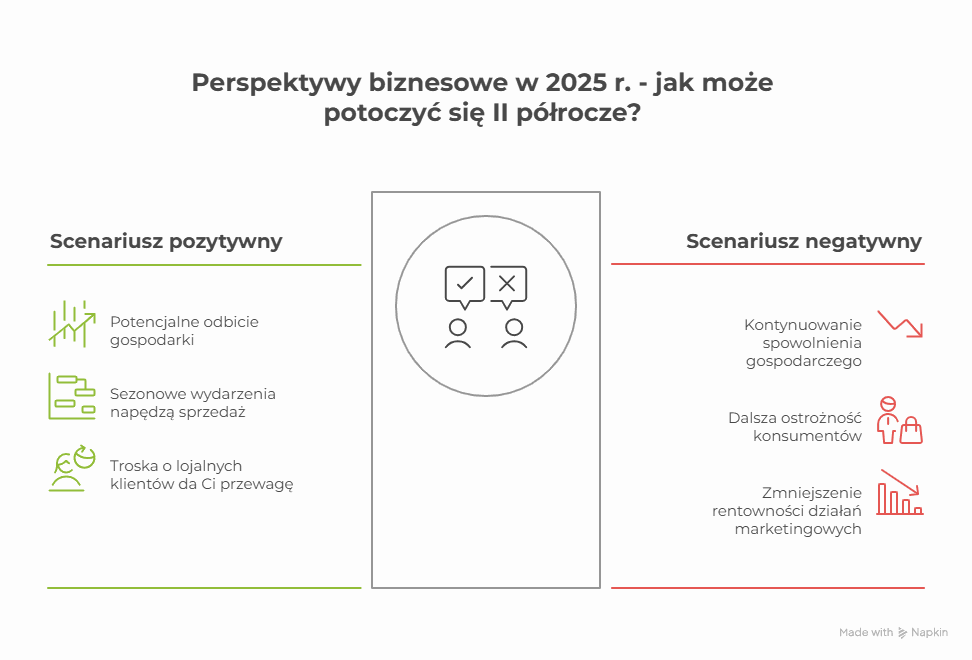
The pessimistic scenario assumes the current slowdown continues, especially in categories tied to impulse purchases - such as fashion, electronics, or seasonal products. High consumer caution could translate into further declines in retail sales, while rising ad campaign costs (not least the steady increase in Allegro CPC rates) could squeeze the profitability of marketing efforts. Companies that don't react early enough may be forced to cut spending, pull back from marketplaces, or reduce their resources.
There's a more positive scenario too, though. If inflation stays under control and the job market doesn't weaken, a mild rebound is possible in the third and fourth quarters - driven by back-to-school shopping, the gift-giving season, and Black Friday campaigns, followed later by the holidays. Brands that prepare early for these occasions, adjusting their offer and messaging to their audience's new price sensitivity, could not only hold their ground but gain an edge.
Whatever scenario plays out, the second half of the year will be a test of maturity for many companies. It's a time to look not just at sales campaigns, but at operational fundamentals, loyalty strategy, and the quality of the entire customer experience - from the first click all the way to checkout.
New regulations and legal changes in 2025
The second half of 2025 brings a series of legislative and regulatory changes that will affect businesses, sellers, and marketers in Poland (and across the EU). Here are the most important ones:
The AI Act
The first comprehensive AI regulation in EU history came into force in 2024, and starting in February 2025 its key provisions begin to apply. These rules ban certain practices deemed too risky, such as AI systems that manipulate human behavior, social scoring of citizens, or remote biometric identification of people in public spaces. From August 2025, obligations will kick in for providers of so-called general-purpose AI (such as large language models like ChatGPT), and penalties for non-compliance will start being enforced. The AI Act requires businesses using AI to be more transparent - for instance, if content (image, audio, video) has been generated or manipulated by AI, this must be clearly disclosed at the very first point of contact with the audience. In addition, providers and users of AI systems will have to meet requirements proportionate to the AI's risk level (high, limited, or minimal) - the more serious the algorithm's potential impact, the stricter the standards for documentation, compliance assessment, and oversight.
For companies using, say, recommendation algorithms or content generators, this means checking whether their tools fall under the new regulations and potentially registering or reporting such systems as required by law. It's worth noting that national initiatives are underway too - the Polish government is, for example, discussing a list of professions protected from AI (so that in certain fields, algorithms don't replace people) - which shows a broader trend of growing oversight over the use of artificial intelligence.
The Digital Services Act (DSA)
The EU's Digital Services Act (DSA) has been fully in force since 2024, but its effects continue to shape market practices in 2025 as well. The DSA places numerous obligations on online platforms: from mechanisms for quickly removing illegal content, to a ban on manipulative interfaces (dark patterns), to new restrictions on personalized advertising. In practice, the DSA bans profiling ads targeted at minors and using sensitive data (ethnic origin, political views, health, orientation, etc.) for ad targeting. Global platforms like Facebook, Instagram, TikTok, and YouTube have had to adjust their policies - for example, in the EU, users can now more easily opt out of a personalized feed in favor of a chronological one, and platforms must provide tools for reporting illegal material.
For marketers, the DSA means having to rethink targeting strategy - precise campaigns built on detailed profiles are harder to run, especially for younger audiences. Ad content also needs care, to avoid using banned techniques of influence. Overall, the DSA raises the transparency bar across the digital ecosystem, which ultimately builds user trust, but in the short term may make some marketing activities harder (such as retargeting with its previous effectiveness).
Political advertising regulations
The EU has adopted new rules on the transparency of political advertising. They'll start applying from October 2025 and are meant to prevent hidden propaganda and foreign interference. In practice, every political ad will need to be clearly labeled, along with information about the sponsor, campaign budget, and the targeting criteria used. Targeting for such ads will also be significantly restricted - only allowed based on data that the user has explicitly shared for political purposes, and sensitive data cannot be used at all. A ban on running political ads funded from outside the EU has also been introduced for the three months before elections.
While these regulations primarily concern electoral committees and organizations involved in political marketing, they indirectly affect the entire online advertising ecosystem - platforms must implement mechanisms to identify and label such ads, and users will get tools to check "why am I seeing this political ad." For marketers in the commercial sector, it's a signal that transparency in advertising is becoming the norm well beyond politics, and that regulators will keep a closer eye on targeting practices and the labeling of sponsored content.
Summary
The coming months will bring plenty of challenges, but also opportunities for companies ready to adapt quickly to the changing landscape. Rising price pressure and consumer uncertainty will push brands toward even greater transparency, flexibility, and quality. In a world where competition plays out not just at the product level but at the level of experience, the winners will be those who skillfully combine technology with a human touch and strategic thinking. The second half of 2025 could be a time of stabilization or a turning point - depending on how ready companies are to act.
Sources used:
- Retail sentiment report for Q2 2025 - SGH Institute for Economic Development
- UCE Research report (June 2025)
- DHL eCommerce 2025 report
- E-commerce Marketing Trends 2025 - Taboola
- Content marketing trends in 2025 - Statista study
- 2025 marketing trends - Kantar
Want to find out how we can help you adapt your business to the changes happening in 2025?
Click below or fill out the form: