Marketing
Chatbeat: Track Your Brand's Visibility in AI Search
Does your brand show up in the answers given by ChatGPT, Gemini, or Perplexity? Chatbeat is a modern tool that shows how AI perceives your company and how you stack up against the competition. Find out what users are asking and how to effectively boost your visibility in the new era of search.
AI going mainstream has left marketers facing a new problem - how do you effectively measure results from these search tools? Is a brand visible in the answers produced by generative language models (LLMs)? After all, more and more people are using them, and it's an area that matters a great deal for marketing.
Helping to make sense of this puzzling topic is Chatbeat - a new tool that lets companies monitor how often - and in what context - they show up in the answers given by popular AI chatbots. We tested how this tool works in practice and who stands to benefit from it most.
Why does AI visibility matter so much?
Not long ago, classic search results (SERPs) were the main way people found content online, but as language models have grown in popularity, Google's dominance has slipped somewhat. Today, more and more users ask questions directly to AI - from ChatGPT to Gemini or Perplexity. These are becoming the new "touchpoints" with a brand - not just mentioning it, but also citing web sources the user can then click through to. Chatbeat lets you track this phenomenon: it checks how often your brand appears in chatbot answers and what questions it's associated with. This gives you a better understanding of a brand's digital presence within this new information ecosystem.
What does Chatbeat offer?
Chatbeat helps you better understand traffic coming from "chats" - not just its volume, but also its scope and intent. It shows the context in which a given brand or website appears. As a result, it's a great complement to an SEO and content marketing strategy, making it easier to respond to what users actually need. Chatbeat offers a range of analytics features built around several key areas:
User intent
Chatbeat gathers data on the questions users most often ask chatbots in relation to your brand or industry category. For example, for a cosmetics brand, this might include questions like: "What's the best micellar water?" - if ChatGPT recommends your brand and ranks it high in its answers, that's a sign you're on the right track.
Comparing AI search visibility
The tool compares how different chatbots answer the same questions - and what position a given brand achieves in each. It often turns out that, say, Perplexity cites different sources than Claude or Gemini. That's crucial when planning a content strategy.
Spotting trends
You can track emerging trends in what users are asking. If, say, questions about a particular cosmetic ingredient suddenly spike, that's worth acting on quickly from a marketing standpoint.
Comparing sources
You can see which chatbots generate specific questions. Is more traffic coming from ChatGPT, or from a newer entrant like DeepSeek?
Chatbeat's features - what exactly does the tool measure?
Chatbeat provides precise data on how your brand shows up in answers generated by AI chatbots. But it's not just about "are we visible" - it's about how often, at what position, in what context, and against whom.
The Chatbeat dashboard looks modern and clean. At its center is a panel showing brand visibility along with key metrics. Here are the most important metrics the tool provides in its dashboard:
1. Brand Score & Average Position
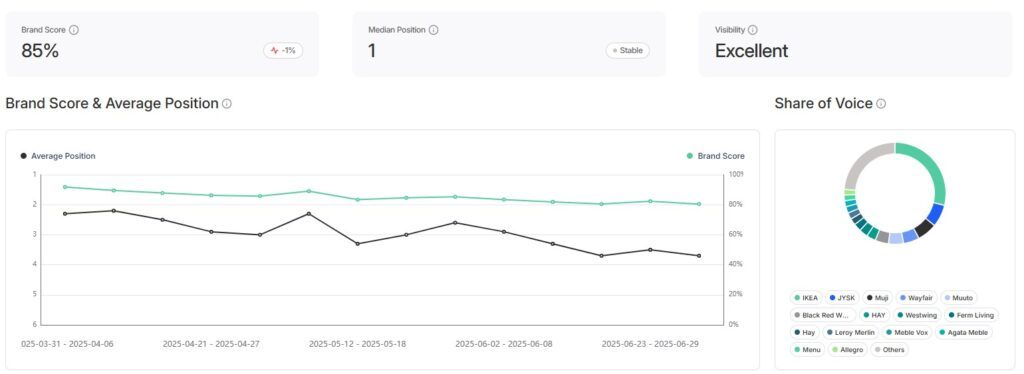
Brand Score is one of the main metrics Chatbeat offers - and one of the most condensed. It shows how well your brand performs across AI answers to a given set of queries. What is Brand Score? It's a percentage-based visibility metric, calculated from your brand's position in AI results. A brand that regularly appears in the top spots can score close to 100%. Average Position complements this - it tells you the average rank at which your brand appears. Think of this metric as the AI equivalent of a classic Google ranking. The higher you rank, the greater the chance a user will remember your brand - or even treat it as "AI-recommended."
2. Share of Voice - your brand's share of AI answers
Share of Voice (SoV) is a metric that shows what percentage of all "recommendations" or mentions in AI answers goes to your brand - compared with the competition.
The system weights position within the answer - first place accounts for as much as 40% of the share, second place 20%, third place 10%, and so on. All brands always add up to 100% of the share for a given query.
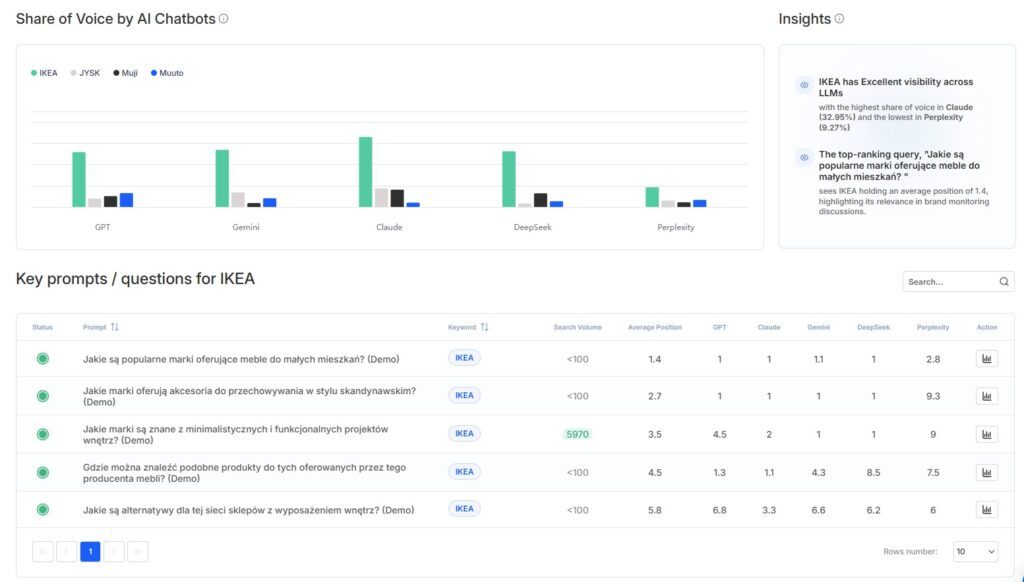
Chatbeat breaks Share of Voice down by specific language model - so you can see how your brand performs individually across:
- ChatGPT,
- Gemini,
- Claude,
- Perplexity,
- DeepSeek.
That matters, because not every AI platform draws on the same sources, and not every one "likes" your brand equally. So you can see not just whether you're present, but where you're present - and where it's worth putting in more effort.
3. Insights - an automatic summary of your results
The "Insights" section is a quick overview of your brand's standing, generated automatically by Chatbeat. You get short, ready-to-quote summaries, such as:
"Company X has the highest share in Perplexity (40.41%) and no visibility in Claude and Gemini. Best-performing query: 'What's the best micellar water?' - average position: 2." This kind of message can feed straight into internal reports, updates for management, or even leads for your content/SEO team.
4. Key Questions / Key Prompts
This is a very practical feature. It shows what questions users are asking AI within your category - and which of them your brand appears alongside.
Example: for a brand in the cosmetics sector, this might be a question like: "Where can I buy Korean cosmetics?" - if a chatbot recommends your company, it means you're well positioned for that particular need.
This isn't just a way to analyze your current standing, but also inspiration for creating content:
- blog posts,
- guides,
- dynamic ads,
- and even prompts for your own chatbots!
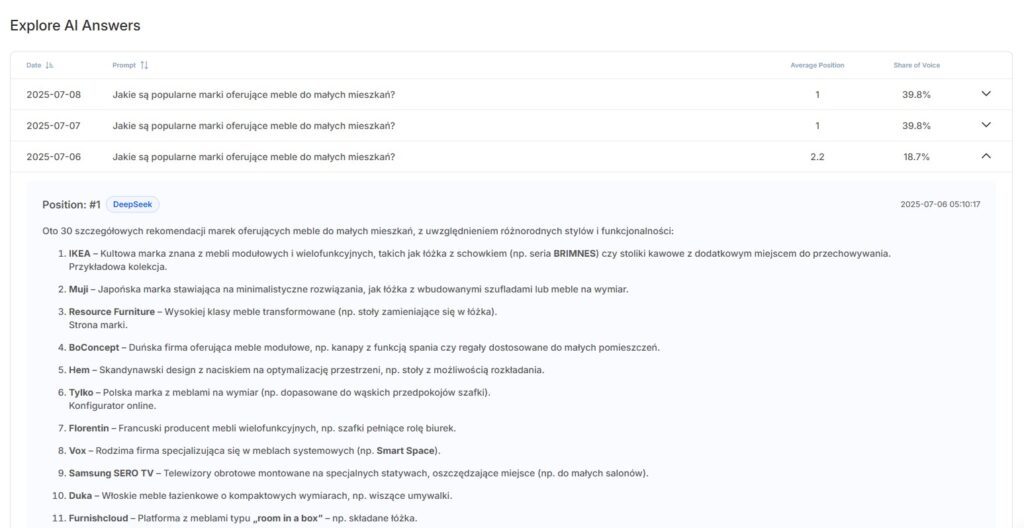
You can review historical answers to a given prompt or query and see how they've changed over time, as your brand's position and Share of Voice shift. This is a genuinely fascinating aspect of the tool.
5. Key Sources - where does AI get its data from?
This feature lets you peek "behind the curtain." Chatbeat shows which sources AI chatbots draw on when generating answers related to your industry or products.
This could be your blog, a niche industry site, articles on comparison platforms, or sites like Reddit. Knowing which sources "feed" AI lets you:
- strengthen your presence on them,
- publish sponsored articles on outlets that carry weight with LLMs,
- identify content gaps that your content could fill.
With these features, Chatbeat doesn't just let you measure your brand's current AI visibility - it also gives you concrete pointers on what to do to improve it, whether through content, PR, SEO, or optimizing your sources.
At a time when users increasingly ask "which company is best for X?" or "which Y products are best?", data from Chatbeat isn't just interesting - it's strategic.
How can I use Chatbeat at my company?
Chatbeat is a tool built primarily for:
- marketers working on brand visibility in AI,
- SEO and content specialists,
- PR and brand management teams,
- agencies tracking their clients' reputation in this new search environment.
In a world where queries are shifting from Google to ChatGPT, Chatbeat can become an essential source of insight and the foundation for a new brand-presence strategy.
Picture a company offering AI-based project management tools. Using Chatbeat, it discovers that users are asking: "What AI tool should I pair with Trello?" - and that competitors show up more often in the answers.
Based on that, the team creates a series of articles, optimizes its own presence within ChatGPT (for example through llms.txt or PR efforts), and after a few weeks Chatbeat shows a 35% increase in visibility. That's a real competitive edge.
Our impressions and takeaways from using Chatbeat
Chatbeat stands out from typical analytics solutions mainly because it addresses an entirely new search reality, built on answers generated by language models. Instead of only analyzing traditional SEO or social media, Chatbeat lets you look at how your brand shows up in conversations with AI chatbots - from ChatGPT to Gemini, Claude, Perplexity, and DeepSeek.
What particularly stands out is that the tool covers multiple models in parallel, giving a full picture of a brand's presence across the so-called "AI visibility landscape." The data is current, precise, and presented in an accessible way - for analysts and non-technical users alike. Tracking user questions, analyzing ranking positions, measuring market share (Share of Voice), and identifying key content sources - all of this makes it easy to turn data into concrete marketing decisions quickly.
What's more, Chatbeat's interface is modern and intuitive, and the automatically generated "insights" genuinely save time. The tool works excellently as a compass for content marketers, SEO specialists, PR teams, and anyone responsible for brand visibility in today's search ecosystem.
Of course, like any solution, Chatbeat has its limitations. There's currently no free version, which could be a barrier for smaller companies. There's also no open API yet, nor more advanced segmentation, which limits its use in large, highly automated analytics environments. But it's only fair to note: this is a fresh, fast-evolving tool - and its potential clearly outweighs these minor shortcomings.
In short, Chatbeat is an innovative, much-needed tool arriving at exactly the right moment - as AI search becomes the new standard. For marketers, SEO and content specialists, PR teams, or agencies monitoring client reputation, Chatbeat can become not just a support tool but a genuine foundation for a communication strategy. If you want to know what AI is saying about your brand - and how to get it to say more - Chatbeat is a tool worth having in your arsenal.
Not sure whether Chatbeat is the right choice for your company? Get in touch with us - we'll help you choose the right tools to simplify your work, optimize your marketing efforts, and boost your brand's visibility exactly where customers are looking for answers today - in AI.