Marketing
The Challah Horse, Boomer Bait, and the Evolution of Cyber Threats
They made a horse out of challah bread, and nobody congratulated them... Find out what's behind this phenomenon and what it leads to. Discover what AI slop and boomer bait are, and how to avoid getting caught in digital traps!

Recently, a horse made of challah bread - built by a diligent young woman whom nobody congratulated - took the Polish internet by storm. The image spread across social media, and other businesses and entrepreneurs quickly jumped on the trend, creating their own variations: challah crocodiles, challah planes, challah printers, and even a challah-Tomahawk pun made an appearance. It's a great example of real-time marketing (RTM) - and of how a popular trend can be used to promote a brand or offer, while adding a bit more to the pile-up of jokes. Now that the Challah Horse's gallop has run its course, let's think about what conclusions this phenomenon offers - and what we can learn from it.
Article summary
The Challah Horse phenomenon became a symbol both of the creative use of internet trends and of the problems tied to mass-produced AI content. AI slop, boomer bait, and engagement-farming mechanics show how social media algorithms favor the spread of low-value content by playing on users' emotions. The key takeaways are the need for proactive behavior, digital literacy, better tools for identifying AI-generated content, and regulation to prevent this kind of mechanism from being used with bad intentions. Ultimately, responsibility for the shape of the internet rests with users, platforms, and lawmakers alike - only conscious media use can limit the harm these phenomena cause.
AI slop - the Challah Horse for all to see
The Challah Horse was born in early January as a post on the Facebook page "Polska w dużych dawkach" ("Poland in Large Doses"), meant ironically - it mocked the growing trend of posting AI-generated images depicting all kinds of people and situations on Facebook: farmers, gifted artists and inventors, or - in a throwback to an older internet tradition - wishes of good luck and health in exchange for a like or a share. All, of course, dressed up with an equally striking image. What they all have in common is that they're AI-generated, which a trained eye can spot from their lack of sincerity, and some images, like the Challah Horse itself, carry a dose of absurdity.
Content like this earned the label AI slop - a term for mass-produced, AI-generated content of fairly low substantive value, cheap and quick to produce, that floods the internet.
It's worth noting this isn't limited to images. Sites that automatically publish generated sports articles or how-to guides are another example, often misleading or simply nonsensical. Videos have started appearing too, whether as short-form clips or full-length productions. These are often recycled from other existing content (for example, "TOP 5 hottest peppers in the world" based on some existing article or video); on YouTube you can also find AI-invented content that isn't true (we spotted, among others, a channel that "makes up" roller-coaster accidents - we recommend this excellent English-language video on the topic).
So let's get to the point: what makes this content "clickable," and what does it lead to?
The economics of junk content
On the Polish internet, AI slop is by far most common on Facebook. Looking through profiles, these are usually fan pages that share it further - though they don't always consist purely of AI-generated images. These images come with captions that encourage interaction, almost always by leaning on some emotional hook - nobody congratulated her, you won't say hi to me because I'm a farmer, and so on. This stirs up empathy and encourages people to leave a kind word and a like. That's exactly how you get caught - Facebook notices what triggered a positive reaction from you and starts serving you more of the same, you react again, and the profile owners get exactly what they were counting on.
This practice is called engagement farming, often referred to in Poland as a "like farm." Page owners create content designed to maximize user interaction - likes, comments, and shares - through clickbait, emotional manipulation, and viral appeal. Social media algorithms promote this kind of content based on user interactions, which drives it to spread widely. That's how the Challah Horse itself started to "gallop," dragging similar content along behind it.
This kind of practice leads to a flood of low-quality content, making it harder for users to access reliable information - but more importantly, creating AI slop is driven mainly by the desire for profit. Profiles (and, more broadly, websites or blogs) that publish this kind of content attract traffic, which they then monetize. On Facebook and other social platforms, such an account is usually fairly anonymous, with a generic name often tied to patriotism, family values, health, or religion. Someone susceptible to this kind of content often follows several such profiles, which makes it easy to "take over" one of them and quietly turn it into, say, a profile selling products, without anyone noticing. Websites work the same way, except there you just need to add ads to the page, and the incoming traffic generates income on its own. Here's how the process typically plays out:
Create an account -> produce emotionally charged, clickbait content -> collect reactions -> expand reach through algorithmic suggestion ("promotion" by the algorithm) -> promote the profile with ads, grow the account -> sell the data/account to another party
This cycle can run across several profiles at once, flooding an ever-larger part of the internet with "slop," ad nauseam. It's worth adding that sold accounts often target the same audience, for example promoting dietary supplements or insurance.

Let's look out for older internet users
If you've ever wondered how anyone could fall for the Challah Horse and other forms of AI slop, you're probably not in the target audience. Facebook today is used by an enormous number of people - as the internet and technology have spread (smartphones especially), the platform's user base has broadened considerably. Our parents, uncles, and grandmothers use Facebook, and they sign up to stay better connected with family, play games, take part in groups (sadly, as internet forums fade in favor of Facebook groups), and, of course, browse funny videos and memes. As a result, older users tend to have less technical knowledge and fluency, which is exactly what makes them a target audience. Boomer traps (also known as boomer bait) are content created specifically with them in mind, designed to trigger strong emotions or nostalgia. Beyond posting images like the Challah Horse to farm likes, this content often takes the form of fake contests, sensational news, or conspiracy theories, which spread easily through social media. This mechanism preys on a lack of awareness and knowledge, making such users vulnerable to manipulation and disinformation.
Look at it this way: how likely is it that an older user knows what liking or clicking on something actually does, and how it feeds into Facebook's or Google Ads' algorithm?
Unfortunately, that likelihood is slim. Older users don't know about these mechanisms, and most likely have no interest in them at all. It's also harder for them to verify the credibility and reliability of content, especially once they're surrounded by a circle of profiles and sites of dubious quality that the algorithms keep serving them. That builds up a substantial risk.
The Trojan Horse (made of challah) - three attack vectors used by cybercriminals
Here are three attack scenarios involving cybercriminals, a Facebook profile that collects interactions from older users, and the users themselves.
Phishing through a shared post with a link
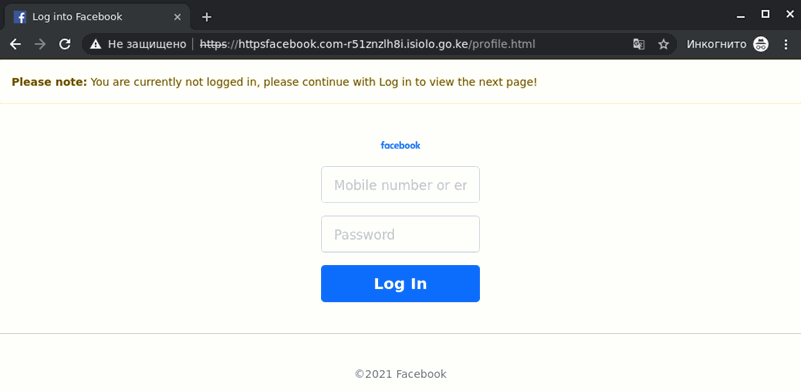
A Facebook profile builds a following within a specific target audience by consistently sharing content. One post, using the same emotionally charged framing (a post about a security-camera recording of a child being abducted recently circulated on Facebook), shares an external link. That link leads to a carefully crafted page which, posing as the Facebook login page, can be used to steal login credentials, or to redirect the victim into a kind of cybercrime "funnel" that leads to financial fraud (for instance, by getting them to enter their credit card details).
Deepfakes and impersonation
Similar to the previous scenario, a fan page might run (via a post or an ad) a clip in which a well-known person appears to promote some service - often an investment scheme. The person's high credibility, combined once again with emotionally charged, personal language of benefit (Right now your life is about to change, I'm giving you a once-in-a-lifetime chance), can be enough to persuade a victim, especially one who can't tell the impersonation apart from the real thing. Victims have included Rafał Brzoska, Cezary Pazura, Hubert Urbański, and users who suffered financial losses after falling for the attack.
Below is an example of one such ad, with one telling detail - the AI voice slips up, changing its accent midway through the clip. It also includes the now-familiar, unintentionally funny line "no need to introduce myself," which has shown up in many campaigns of this type.
Profiling and direct contact
A fan page owner has the ability to analyze their audience in depth. Further profiling lets them single out users who show high engagement and susceptibility to manipulation - in other words, potential victims. From there, the victim might be contacted directly by someone behind the page (to appear credible), or handed off to another criminal.
It's also worth factoring in data collection and the previously mentioned sale of the account to a party that may later use it to promote dubious services or products. Every interaction can be used by the page's operators to gather data on engaged users, and information about user preferences and behavior is extremely valuable in marketing. And all of this can be set in motion just by liking a few seemingly innocent posts!
How not to get taken for a ride
The single most important thing is education and awareness of the potential risk that can come from these seemingly innocent bits of media. We can each start by informing friends and family and spreading the word. There are also browser extensions that help detect whether a given piece of content or image was artificially generated.
Ultimately, though, defense needs to be proactive. It would be wrong to assume that every Facebook profile sharing this kind of content is malicious by nature, though it can, to some extent, be classified as disinformation. Users can report a profile and request a review if they believe it violates Facebook's terms of service or community standards; the same applies to other social platforms. Suspicious sites and any incidents can be reported to Poland's CERT Polska.
Looking further ahead, we need legal regulations that require AI content to be labeled, better technology for detecting AI-generated material, and a stronger sense of social responsibility from platforms for the content they distribute. This would help not only reduce the risk, but also protect the intellectual property of creators whose work is used to generate content without their consent.
It's worth remembering that the future of the internet depends on all of us. Given the growing presence of AI-generated content, and its spread among an ever-wider range of internet users, we should stay alert and more critical of what we find online. The Challah Horse phenomenon raises questions about the authenticity and value of information available online, and about the potential danger that can hide behind something so seemingly innocent.
Every one of us is vulnerable to a cyberattack - even people who are quite savvy online or well aware of cybersecurity issues, as shown by the WebWyrm cybercrime campaign, which specifically targeted, among others, IT and digital marketing professionals (report in English). It's often said that any lock can be picked given enough time. So let's stay proactive and watch out for the threats that increasingly lurk online.