Marketing
The Cloudflare and AWS Outages: Can You Avoid Them?
On November 18, 2025, a Cloudflare outage knocked out hundreds of services - from online stores to everyday work tools. What caused it, and how can you protect your business against the next one?

On November 18, 2025, a large part of the internet stopped working. Not because of a cyberattack or a spectacular breach, but because one of the largest network infrastructure providers - Cloudflare - tripped over its own configuration. A few weeks earlier, Amazon Web Services suffered a similar fate, when DNS problems set off a domino effect across half of the world's online services.
What exactly is Cloudflare, and why does so much of the internet run on it?
Cloudflare is a global internet infrastructure platform that acts as a go-between for the user and your server (your site, your files, and so on). It's most commonly used in three main areas.
First: speeding up sites and apps. Cloudflare acts as a CDN (Content Delivery Network) - a network of servers spread around the world. With Cloudflare, your site's content is stored closer to the user, so it loads faster and puts less strain on your server.
Second: security. The platform filters traffic, blocks DDoS attacks, rejects suspicious requests, and protects the server through what's called a reverse proxy. In practice, most traffic hits Cloudflare first, gets analyzed, and only then gets passed along. You may have noticed this yourself - a Cloudflare screen sometimes appears before a page's content loads.
Third: reliability and traffic management. Cloudflare also offers DNS (the system that routes a domain to the right server), routing rules, load balancing, and a range of tools that help keep services stable. For many businesses, Cloudflare is a single "front door" that handles all incoming traffic.
As a result, Cloudflare has become a piece of critical infrastructure for a huge share of the internet: online stores, SaaS platforms, mobile apps, news sites, financial services, and ordinary company websites. That's why, when Cloudflare has problems, millions of users and thousands of businesses see it instantly - even if they don't use its services directly.
What exactly happened during the outage?
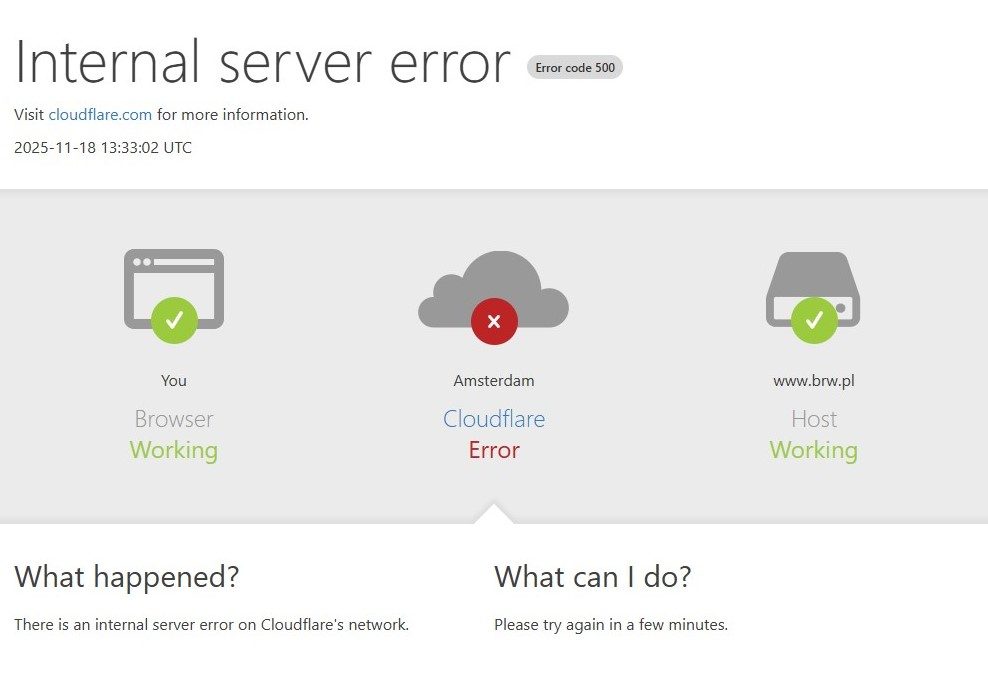
On November 18, 2025, at around 12:20 pm Polish time, Cloudflare's network started returning HTTP 5xx errors en masse for traffic across many sites and services. This wasn't an attack - Cloudflare made that clear itself. (Reuters: the scale of the outage) The problem arose when a configuration file for the Bot Management system grew too large after a change to database permissions. The file ultimately exceeded its size limit, which caused a failure in the software that handles Cloudflare's network traffic.
How did the outage hit businesses?
The effects were plain to see. Many websites and business tools stopped working - admin panels, CRMs, analytics dashboards, ticketing systems. Employees logged in only to see errors, while IT teams tried to diagnose the situation remotely, using tools that... might also have depended on Cloudflare.
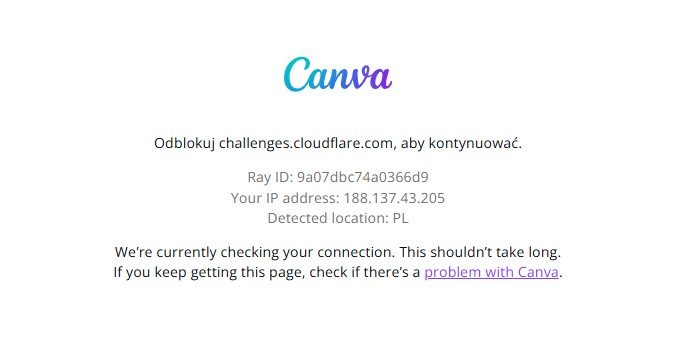
On the popular platform Canva, users lost access from one minute to the next:
Perplexity stopped working too:

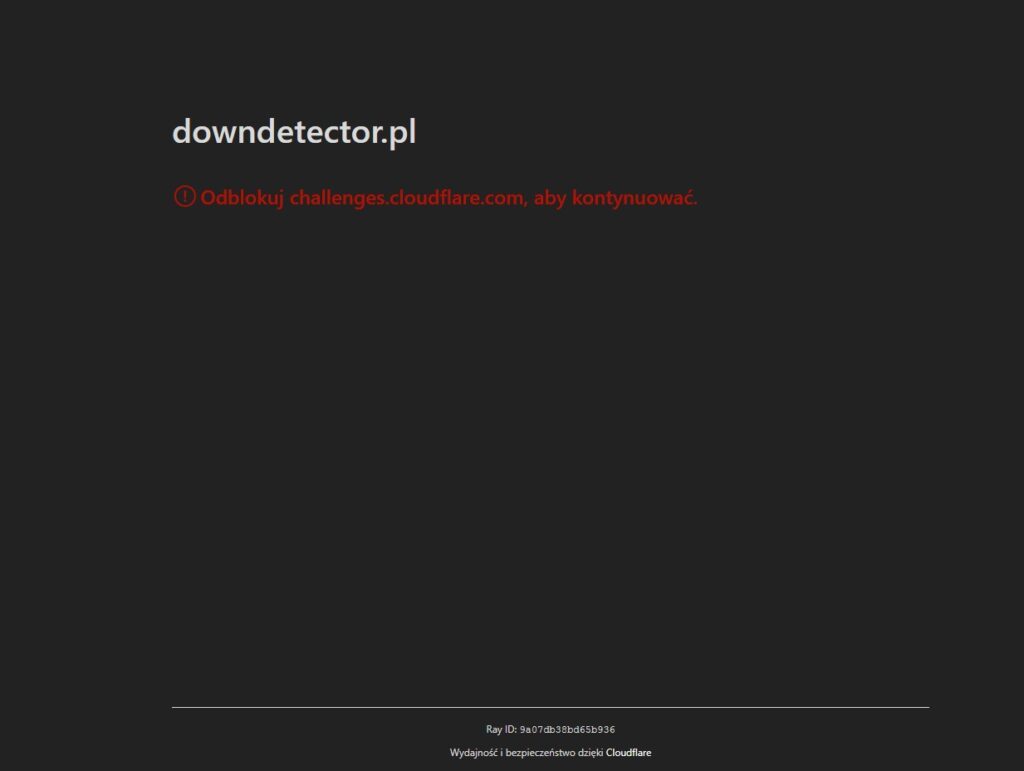
Among the sites and services reporting problems were Amazon, X (formerly Twitter), Spotify, Uber, ChatGPT, iSpot, x-kom, and Black Red White. Even the well-known site DownDetector, which many people use as a quick way to check whether a given service is having issues, stopped working:
For some users, the outage simply meant slower progress or a pause on current tasks that relied on tools or services affected by it. In reality, though, Cloudflare is estimated to power around 20% of the entire internet - so your experience of the outage could have been completely different from someone else's, and instead of a short coffee break, it might have wrecked the rest of your workday.
Online retail, for example, took a serious financial hit. E-commerce sites relying on Cloudflare's services slowed down or stopped functioning altogether. If an ERP system or API integrations also ran through Cloudflare, orders couldn't just fail to be placed - they couldn't be processed either. Even a single hour of downtime is enough to generate real losses.
What can you do to avoid being caught off guard next time?
A realistic response plan - internal and external
The fastest and simplest thing worth putting in place for situations like this is a solid plan - internal and external. An internal plan should spell out clearly what to do when a key service stops working. Who makes the decisions, which communication channels serve as backups, which processes can be run manually, and which get frozen. This doesn't need to be hundreds of pages of documentation - it just needs to be a clear, short set of procedures that employees know and can follow. Nothing calms a team down faster than knowing the situation has been anticipated.
An external plan, meanwhile, means having customer communication ready to go. There should be a status page independent of your main infrastructure, prepared messaging, and a set frequency for updates. Customers will forgive an outage, but they won't forgive silence - and silence is the most common mistake businesses make in these situations.
Redundancy
You can build an alternative to Cloudflare. A second DNS provider, a separate CDN, the ability to route traffic directly to the server, or backup infrastructure alongside the main one. All of this is technically achievable - it just isn't necessarily cheap, simple, or justified for everyone.
Redundancy pays off wherever every minute of downtime means a real financial or reputational loss: large e-commerce operations, B2B SaaS companies, subscription services, and businesses with SLAs to uphold for clients. For small and medium businesses, the costs can often outweigh the benefit, though the worst strategy of all is betting that "it won't happen again." Of course it will. It's only a question of whether you'll be ready when it does.
Is there a takeaway from this incident?
Hard to say. Even if you don't use Cloudflare (or AWS) directly, the tools you rely on probably do. That's enough to throw a wrench in your plans. The Cloudflare outage, coming on the heels of the AWS outage, is a reminder of one blunt truth: the internet isn't reliable, and your business, whether it likes it or not, depends on things it doesn't control. This isn't about giving in to paranoia and building your own data center in the basement. It's about being aware of the risk, having a sensible response plan ready, and thinking through which parts of your setup genuinely need safeguards. And the Cloudflare outage is another good "reminder" to give this some thought at your own company.
Want to talk about the options available to your business to help you avoid the kind of chaos caused by outages at internet service providers - from self-hosting and data backups to rebuilding your infrastructure?
Click below or fill out the form: