E-commerce
Shoper vs. Shopify: Which E-Commerce Platform Is Right for Your Business?
Trying to decide between Shoper and Shopify? This guide compares their features, integrations, templates, payments, APIs, dropshipping support, and pricing. Whether you're building a Shoper store or considering a move to Shopify, you'll find concrete facts and recommendations here.
Choosing the right e-commerce platform is a critical decision for any entrepreneur planning to sell online. In this article, we look at two popular solutions - Shoper and Shopify - which take different approaches to building and running an online store. We compare them in terms of features, integrations, growth potential, and cost, to help you pick the tool that best fits your needs and business strategy.
In this article, you'll learn:
- Which e-commerce platform is best for a small store?
- Which platform better supports international sales?
- What does product management and ERP integration look like?
- How do templates and customization options differ between Shoper and Shopify?
- How do payments and delivery work on these e-commerce platforms?
- What can the Shoper and Shopify APIs do?
- Is Shopify a good fit for dropshipping?
- How much does a Shopify store cost?
- How much does a Shoper store cost?
Who is Shoper for, and who is Shopify for?
Shoper is a Polish e-commerce platform that works best for companies focused on domestic sales. It offers native integrations with Przelewy24, PayU, Tpay, BLIK, InPost, DPD, and Allegro. Ready-made modules and an intuitive interface let you start selling without needing significant technical resources.
Shopify is a global platform built to support international sales - with support for multiple languages, currencies, taxes, and local settings. Thanks to automatic content translation and access to thousands of apps, it's ideal for companies thinking about expanding abroad.
Product management and ERP integrations
Integrating an e-commerce platform with an ERP system is becoming an increasingly important factor when choosing a platform. Shoper lets you manage products and their variants from a simple panel. It also offers integrations with ERP systems like Subiekt GT or Enova. That makes it a solid solution for mid-sized companies that need to connect their store to accounting or warehouse systems.
Shopify offers far greater capabilities - support for thousands of products, custom fields, tagging, dynamic collections, and advanced import/export. For larger companies and catalogs, Shopify is simply more scalable.
Templates and store design customization
Shoper offers ready-made templates that can be deployed quickly, with no coding knowledge required. Its new Storefront system allows for mobile-friendly design and compliance with the European Accessibility Act.
Shopify gives you far more freedom. You can choose from free and paid themes, edit HTML and CSS, and use premium themes. For brands that want to build a truly distinctive store look, Shopify is the better choice.
Payments and delivery methods
Shoper integrates with Polish payment providers (Przelewy24, PayU, BLIK) and couriers (InPost, DPD). Setup - especially for parcel lockers - is very straightforward.
Shopify offers Shopify Payments as well as support for Stripe and PayPal. In Poland, you can implement Przelewy24, Tpay, or InPost through apps available in the Shopify App Store. Setup can be more involved, but it offers greater flexibility.
API and integration systems
Shoper provides a REST API and a Front API - for integrating with ERP, CRM, invoicing, and Baselinker. It's a solid option for companies looking for automation within the Polish market.
Shopify offers an Admin API, a Storefront API, and GraphQL. It's chosen by developers and IT companies as a foundation for building custom e-commerce solutions - from apps to entirely new sales channels.
Shopify dropshipping vs. Shoper - which is better?
Shopify is one of the leading platforms for dropshipping. Apps like DSers, Zendrop, and Spocket let you import thousands of products and fully automate order fulfillment. Shopify also makes it easy to get started with ready-made guides and integrations.
Shoper also supports dropshipping - mainly through Apilo and Baselinker - but doesn't offer as many ready-made tools or integrations with foreign wholesalers as Shopify does. It's a solution better suited to more advanced users.
Shoper and Shopify are both SaaS platforms - what does that mean, and what does it imply?
Both Shoper and Shopify are SaaS (Software as a Service) solutions - meaning software available on a subscription model. That means you don't install your store on your own server; instead, you use ready-made infrastructure provided by the platform vendor. Everything - from hosting, to updates, to technical support - is included in the subscription.
The advantages of SaaS stores
The biggest advantage SaaS stores have over self-hosted solutions (like WooCommerce, built on WordPress) is ease of use and a low barrier to entry. You don't need to worry about servers, SSL certificates, updates, backups, or security - the provider takes care of all of that. You can focus on selling, not on technology.
Both platforms also offer ready-made integrations with payment systems, delivery providers, marketing tools, and marketplaces, which significantly speeds up implementation and growth.
The drawbacks of SaaS solutions
SaaS solutions have their limitations too. The most important is a lack of full control over the source code and infrastructure, which can be a barrier for companies that need very specific features or integrations. With a SaaS model, you're also dependent on the provider's policies and pricing - price or terms changes are imposed from the top down.
With a platform like WooCommerce, you get full control over the code and can customize your store with virtually no limits - but you also have to handle security, hosting, updates, integrations, and performance yourself. That means higher hidden costs (time, an IT team, mistakes) and more responsibility on your end.
SaaS store costs vs. self-hosted costs
While a SaaS subscription might look more expensive at first glance, in practice it's often cheaper and safer than open-source solutions. WooCommerce requires paid hosting (at least 50-100 zloty/month), premium plugins, development costs, and investment in security and maintenance. SaaS is therefore a good choice for anyone who wants to move fast, work conveniently, and have predictable costs.
Want an online store that actually sells?
Check out our portfolio and see how we help brands build effective Shoper and Shopify stores.
Pricing - how much does Shoper cost? What's included in each plan?
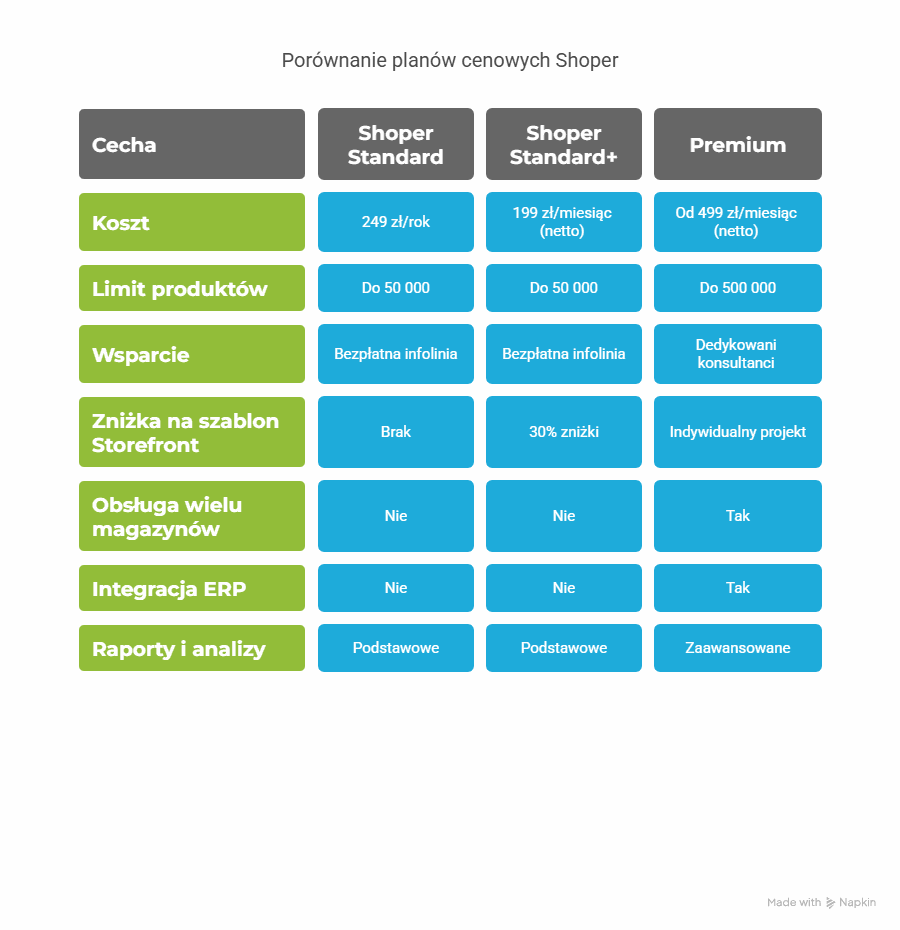
Shoper offers a range of pricing plans tailored to different entrepreneurs' needs. Here are the details on the available plans:
Shoper Standard
Cost: 249 zloty per year
This plan is ideal for sellers just starting out online. It offers:
- The ability to add up to 50,000 products,
- Unlimited mailboxes on your store's domain,
- Free phone support and technical assistance,
- Support for payments, shipping, and returns,
- Two-way integration with Allegro,
- Compliance with the Omnibus Directive and the GPSR regulation,
- The ability to accept foreign payments through Stripe.
Shoper Standard+
Cost: 199 zloty/month net
For sellers who care about a distinctive store design, Shoper offers the extended Standard+ package. This plan includes everything in the Standard plan, plus a unique discount code for 30% off one of the Storefront design templates.
Shoper Premium
Cost: starting at 499 zloty/month net
For larger businesses with specific requirements. This plan offers:
- Everything in the Standard+ plan.
- Dedicated support from consultants and specialists.
- Priority phone support.
- A custom store design, tailored to the client's needs.
- ERP system integrations.
- Advanced reports and analytics.
For large enterprises that need custom solutions, Shoper also offers an Enterprise plan.
Shoper charges transaction fees. These amount to 1.58% per online transaction, so it's worth factoring them into your budget.
Shoper's trial period - how long does it last?
If you want to try Shoper out and compare it to Shopify, you can get a 14-day free trial that lets you test most of the platform's features.
Shopify pricing - how much does it cost? What's included in each plan? Does Shopify offer a trial?
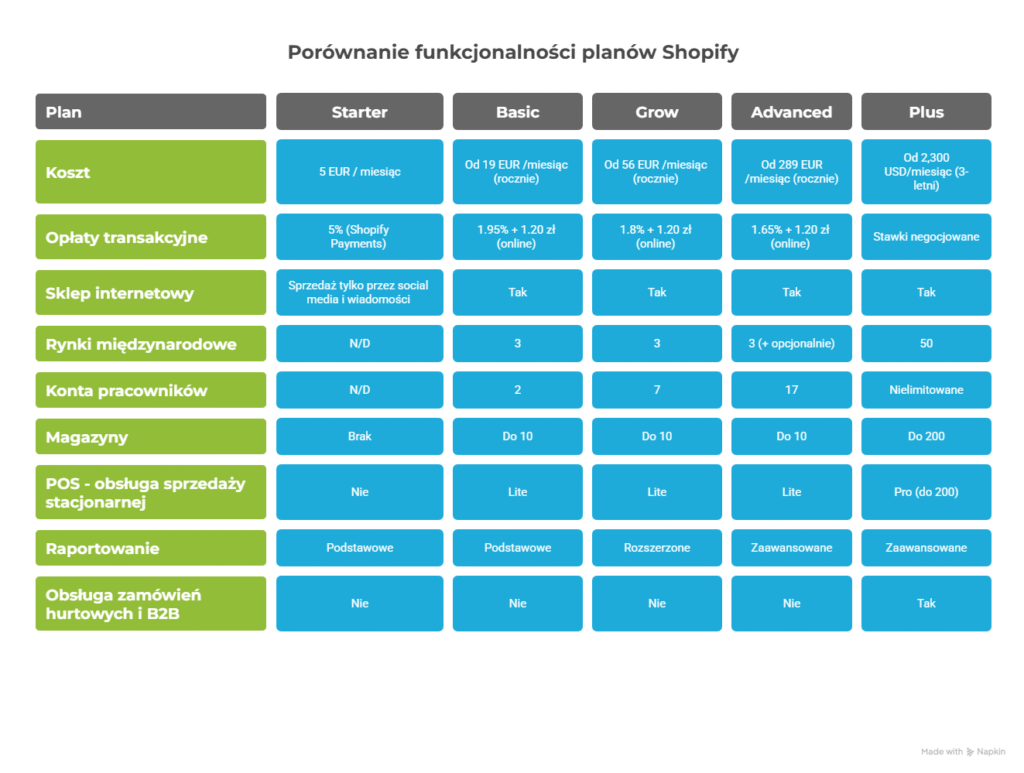
Shopify offers a range of pricing plans tailored to different entrepreneurs' needs. Like Shoper, the platform offers a free, short trial period - lasting 3 days.
Here are the details on the available plans:
Shopify Starter plan
Cost: €5/month. Transaction fees are 5% if you use Shopify Payments.
This plan is designed for beginner sellers who want to start selling through social media or messaging apps. It includes:
- Selling products via links shared on social media,
- No full online store with a shopping cart,
- Basic product management tools.
The Starter plan is a great option if you want to try out Shopify's features and get familiar with the platform.
Shopify Basic plan
Cost: starting at €19/month (billed annually) or €27/month (billed monthly)
Transaction fees: 1.95% + 1.20 zloty for online transactions; 2% for using third-party payment providers.
The best choice for individual entrepreneurs starting to sell online. This plan offers:
- A full online store with a shopping cart,
- The ability to sell in 3 international markets,
- Up to 10 warehouse locations,
- 2 staff accounts,
- Access to POS Lite - a system for handling offline transactions in a physical store.
Shopify Grow plan
Cost: starting at €56/month (billed annually) or €74/month (billed monthly)
Transaction fees: 1.8% + 1.20 zloty for online transactions; 1% for using third-party payment providers.
Designed for small teams growing their business. This plan includes:
- Everything in the Basic plan,
- 5 additional staff accounts (7 total),
- Expanded sales reports,
- The ability to sell in 3 international markets,
- Up to 10 warehouse locations,
- Access to POS Lite.
Shopify Advanced plan
Cost: starting at €289/month (billed annually) or €384/month (billed monthly)
Transaction fees: 1.65% + 1.20 zloty for online transactions; 0.6% for using third-party payment providers.
For growing companies that need advanced features. This plan offers:
- Everything in the Grow plan,
- 15 additional staff accounts (17 total),
- Advanced reports and analytics,
- The ability to sell in 3 international markets, with the option to add more for $59/month each,
- Up to 10 warehouse locations,
- Access to POS Lite.
Shopify Plus plan
Cost: starting at $2,300/month (on a 3-year contract)
Transaction fees: competitive rates for high-volume sellers; details set individually.
Shopify Plus is built for large enterprises that need custom solutions. This plan provides:
- Unlimited staff accounts,
- Up to 200 warehouse locations,
- Priority 24/7 phone support,
- The ability to sell in 50 international markets,
- A fully customizable order fulfillment process,
- Up to 200 POS Pro locations - great for chains of physical stores,
- Support for wholesale/B2B sales.
Comparing Shoper and Shopify - which is right for whom?
Shoper is a good choice for companies operating mainly in the Polish market that need a fast rollout, local integrations, and support in Polish. It works especially well for beginner sellers, small stores, and those who don't plan any advanced customization or international expansion. That said, it's worth factoring in the transaction fees, which can add up at higher sales volumes.
Shopify is the better fit for companies thinking about scaling their sales and entering international markets. Each successive plan gives you more analytics tools, greater flexibility, and more automation options. Shopify requires more effort to set up, but offers enormous room for growth - especially for dropshipping and multichannel sales models.
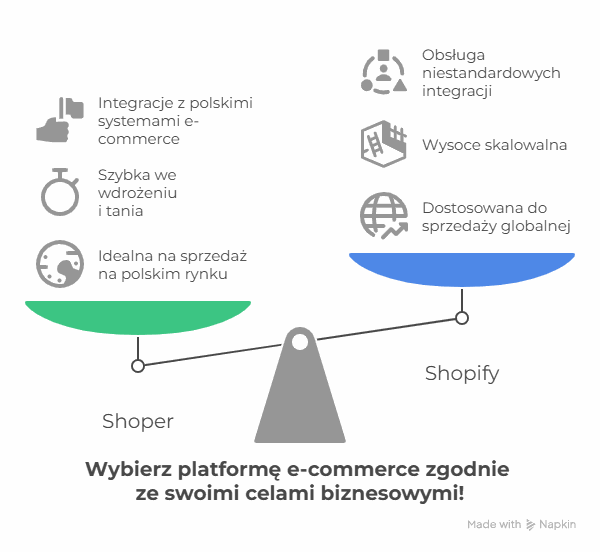
Summary: Shoper vs. Shopify - which platform should you choose?
We hope this article has cleared up any doubts you might have had when choosing an e-commerce platform for your online store. To sum up, Shoper will be the ideal choice if:
- You're focused on selling in Poland,
- You want to launch your store quickly and cheaply,
- You need ready-made integrations with Polish systems,
- You're looking for technical support in Polish.
Shopify, on the other hand, will be the better choice if:
- You're planning an international expansion - Shopify is the solution for e-commerce companies targeting foreign markets,
- You operate a dropshipping business model,
- You want full control, a modern look, and scalability,
- You need custom integrations and apps.
This isn't just a technical decision - it's a strategic one, first and foremost. If you need support choosing a platform, designing your store, or implementing it, get in touch with us. We're happy to recommend the best e-commerce solution tailored to your business goals - and to help you unlock the potential of your e-commerce idea!