Websites
Headless WordPress: What It Is, How It Works, and Whether It's Worth Using
Wondering what headless WordPress is and when it's worth using instead of the classic version of the CMS? This guide explains how a headless architecture works, its advantages and limitations, and in which projects it can genuinely pay off.

In a world of fast-moving web technology, the traditional approach to content management is increasingly giving way to more flexible solutions. One of those approaches is headless WordPress - pairing a proven CMS with modern frontend frameworks. This gives site builders far more control over the look, performance, and scalability of their projects. But what exactly does "headless" mean, and when is it worth using?
In this article, you'll learn:
- What is headless WordPress?
- How does headless differ from traditional WordPress?
- What are the advantages of headless WordPress?
- What are the drawbacks of this approach?
- When is it worth choosing headless WordPress?
What is headless WordPress?
Headless WordPress is a modern approach to content management in which the CMS (the backend used for creating and editing content) operates independently from the site's visual layer. In practice, this means WordPress serves purely as the backend, while the frontend - what the user actually sees - is built using other technologies, such as React, Vue, or Angular.
Instead of a typical WordPress theme, you use an external application that pulls content from the CMS via REST API or GraphQL and renders it on the page. This architecture earned the name "headless," because the CMS "loses its head" - the frontend.
How does headless differ from traditional WordPress?
In classic WordPress, the entire system - the admin panel, the logic, and the frontend - runs as a single PHP application built on the WordPress engine. Users work with ready-made themes and plugins that define both the site's appearance and its functionality.
In the headless version, these elements are separated. WordPress runs "in the background" as a content editor, while the data presentation happens independently, usually through modern frontend frameworks. This gives designers and developers far more freedom to build modern interfaces, without the constraints typical of WordPress templates.
What are the advantages of headless WordPress?
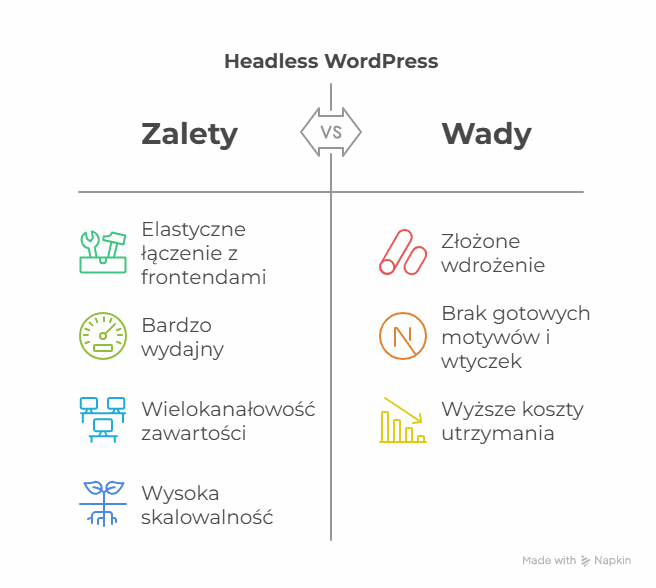
Technology flexibility is one of the biggest advantages - you can pair WordPress with any frontend technology you like. This lets you build a custom interface, a single-page application (SPA), a progressive web app (PWA), or a mobile app.
Performance also improves - the frontend can be hosted separately, for example as a static application on a CDN server, which drastically cuts page load times. This kind of separation also produces better Core Web Vitals results.
Omnichannel delivery is another benefit - content written once can be displayed on a website, in a mobile app, on a smartwatch, or on an information kiosk. This matters especially for brands present across many digital channels.
Scalability - since the backend and frontend are separate services, you can develop them independently, scale them according to need, and even change one part of the system without touching the other.
What are the drawbacks of this approach?
The biggest barrier is implementation complexity - headless isn't a solution "for everyone." It requires a team that knows not just WordPress, but also the frontend technology stack, working with APIs, and performance optimization techniques.
On top of that, there's the lack of ready-made themes and plugins that speed up work in classic WordPress. Everything - from carousels to contact forms - has to be built by hand or deployed as a separate service.
You also can't overlook the higher maintenance costs - separate environments, separate deployments and monitoring, more dependencies, and more points of failure. Headless is cheaper when you have your own dev team or a budget for a software house.
When is it worth choosing headless WordPress?
This solution works particularly well where performance and technology flexibility are essential:
- In high-traffic content sites (such as media outlets or blogs with millions of pageviews),
- In mobile apps with content managed through WordPress,
- In e-commerce, where the frontend needs to be extremely fast and integrated with other systems,
- In large-scale web systems, where WordPress serves purely as a CMS for multiple content channels.
If you want to know whether headless WordPress would be the right fit for your project, get in touch with us. We'll be happy to look at your needs and help you choose the best solution.
Summary - is it worth switching to headless WordPress?
Headless WordPress is a solution for those who need more than the classic CMS offers - flexibility, performance, and the ability to build modern, omnichannel interfaces. For projects that need to be fast, scalable, and integrated with different technologies, headless can be a great fit.
That said, it's not a universal solution. For simple business websites, blogs, or low-traffic stores, classic WordPress will be sufficient, cheaper, and easier to maintain. A headless implementation requires a bigger budget, a technical team, and a well-thought-out architecture.
If your project has ambitious goals and technology is meant to be a competitive edge, headless WordPress is definitely worth considering. But if you're prioritizing speed, simplicity, and low cost, the classic version of WordPress remains a proven choice.
Want to find out whether headless WordPress is the right solution for your site? Get in touch with us, and we'll help you assess whether this technology fits your needs.