Case study
How 5 Months of SEO Doubled a Construction Company's Visibility on Google
PRZEM-BUD had spent years delivering projects for major companies - but the company's website was practically invisible on Google. We checked why. It turned out the problem wasn't what was missing, but what was actively getting in the way. Here's how 5 months of groundwork translated into +143% impressions and historic highs in organic visibility.

project type: SEO
About the Client
PRZEM-BUD is a construction company from Sosnowiec specializing in industrial construction - building production and industrial facilities, industrial foundations, and reinforced concrete structures. The company delivers projects for major companies, including ArcelorMittal, ThyssenKrupp, and EthosEnergy.
Despite a rich portfolio of completed projects and a long-standing online presence, przembud.com wasn't generating any measurable organic search traffic. Customers looking for a general contractor for industrial facilities simply weren't finding PRZEM-BUD on Google.
SEO Campaign Results - January to May 2026
| Metric | Change | Context |
|---|---|---|
| Google impressions | +143% | 3,062 → 7,437 monthly |
| Organic queries | +142% | 90 → 218 unique phrases monthly |
| Organic clicks | +65% | 92 → 152 monthly |
| Phrases in TOP10 (Senuto) | 4 → 11 | Historic high for the domain |
| Phrases in TOP3 (Senuto) | 2 → 6 | Historic high for the domain |
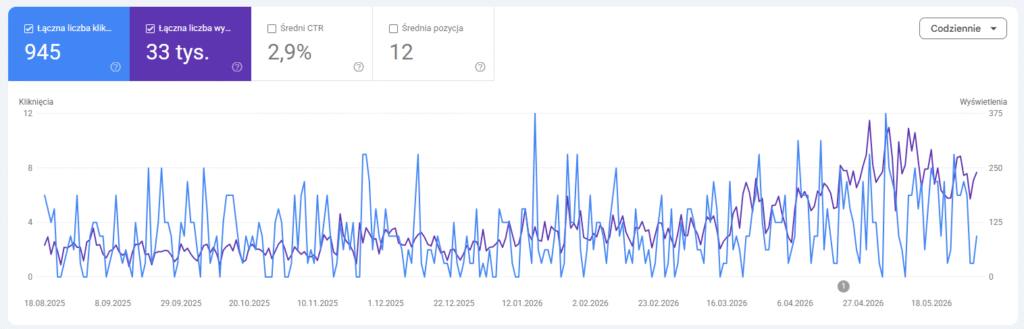
Data from Google Search Console and Senuto. Comparison of January 2026 vs. May 2026.
Starting Point - What We Found
January 2026 was the first month of our collaboration. We ran a site audit before taking any action - and immediately found the main culprit behind the stagnation.
A Sitemap and Indexing Problem
The site had an old, outdated sitemap registered in Google Search Console, left over from a previous version of PRZEM-BUD's website. That's a serious problem for Google visibility - how is Google supposed to know what the current site looks like if it doesn't have up-to-date data about it? Worse still, the sitemap contained sample pages and technical categories from the WordPress theme used to build the site. Google was indexing addresses like these, among others:
przembud.com/project_category/buildings/przembud.com/project_category/plumbing/przembud.com/project_category/driveways/przembud.com/project_category/interior/przembud.com/project_category/design/
So a construction company specializing in industrial facilities was effectively "telling" Google that it worked in plumbing, driveways, and interior design. Instead of the company's real content - leftovers from a template.
The result was that for more than two years before our collaboration, the site's visibility hovered between 2 and 6 phrases in the TOP10 according to Senuto - with no upward trend at all. For years, Google had been "seeing" the site through frosted glass. The site had a ceiling nobody knew was there.
Other Technical Issues
- Missing meta titles and descriptions on key pages (homepage, About Us, Contact, Projects) - or meta content that was too long, duplicated, and lacking keywords.
- A typo in the URL of the About Us page:
/o-fimie-przem-bud/instead of the correct address. - An incorrect URL for the Projects page.
- The blog was tucked away in a dropdown submenu - hard for both users and Google's crawlers to find.
- A 404 page in English, with the default WordPress theme background.
- The H1 heading placed at the very bottom of the homepage instead of at the top.
A Content Problem - References Google Couldn't Read
The company had valuable references from well-known clients - but the reference pages were built in a way Google couldn't properly understand or index. Each reference looked the same: a short heading, a photo, and a scanned reference document as an image.
Google can't read scans. So the reference pages were practically empty to search engine crawlers - no text, no keywords, no context. PRZEM-BUD had dozens of projects for recognizable companies, but Google knew almost nothing about it.
Implementation - Step by Step
Site Design and User Experience
We started work by preparing the site's visual design. The main goal was to create an elegant, calm, and aesthetically pleasing space that would let the wedding photography fully take center stage.
Minimalism played a big role here - cutting back on unnecessary interface elements and keeping the user's attention on the photos. This lets visitors naturally browse through the photographer's portfolio and get a feel for SkyVision's style of work.
The site's structure was designed to be simple and clear. Users can quickly get an overview of the offer, see sample projects, and move on to the contact section.
What We Did - Layer by Layer
1. Technicals and Indexing
This is where we started - because without fixing indexing, everything else would only deliver a fraction of its potential impact.
- We removed the old sitemap from GSC and added a new, current one - containing only the site's real pages.
- We converted unused pages left over from the WordPress theme into draft versions, excluding them from indexing.
- We submitted requests for manual indexing of pages that hadn't yet been indexed by Google.
- We ran a technical Ahrefs audit - identifying URL errors, broken links, and items to fix.
- We fixed the URL typos on the About Us and Projects pages.
- We added rules to robots.txt to restrict indexing of unnecessary pages.
- We fixed the 404 page - switching the language from English to Polish and fixing the background.
- We moved the Blog from the dropdown menu into the main menu.
2. Meta Content
The meta title and meta description aren't a direct ranking factor - but they have a real effect on whether a user clicks a search result. In B2B, where a potential client is comparing several contractors in one browser window, a well-written title and description can be the deciding factor in getting a contact request.
- We wrote and implemented meta titles and descriptions for all key pages: homepage, About Us, Contact, Projects, Offer, Gallery, Blog.
3. References as an SEO Content Engine
This was one of the biggest opportunities we saw in this project. PRZEM-BUD has dozens of completed projects for recognizable companies - but Google knew almost nothing about it.
The old reference pages looked like this:
- A short heading with the project name
- A photo
- A scanned reference document (an image - unreadable to Google)
We began rolling out this new format both for new references and for the ones already on the site.
The new reference pages include:
- An expanded description of PRZEM-BUD's work on the given project - with technology names, scope of work, and specific challenges
- Project details (client, location, scope)
- The actual text of the testimonial from the reference document (not just a scan) along with a quote from the reference's author, presenting their opinion of PRZEM-BUD
- Industry keywords woven naturally into the content
- Internal links to related services and other projects
- The reference scan included as a supplement - not the page's only content
The difference is obvious at a glance. The old reference was a few sentences and a scan. The new one is a full project description with technical context that, on its own, answers questions potential clients might type into Google.
4. Blog - Building Topical Authority
The blog articles served two goals: expanding keyword reach beyond the service pages, and signaling to Google that przembud.com is an expert source in the industrial construction industry. In the first five months, we published expert content including:
- What Types of Foundations Are Used for Industrial Machinery in Practice?
- Reinforced Concrete Structures in Industrial Construction - Requirements, Design, and Execution
- General Contractor for Industrial Investments - When Is It the Best Choice?
The phrase "foundations for machinery" now generates more than 2,500 impressions a month at position 9 on Google - the result of a single article published in February 2026. Over time, it may climb further and generate even more.
5. Google Business Profile
Filling out the business profile strengthened local and brand signals - important for a company operating regionally in Silesia while delivering projects across Poland.
- We fixed a broken image that appeared when the link was shared on social media.
- We added a company and service description, a mobile phone number, and the business's founding date.
- We added a cover photo, the company logo, and profile parameters (service area, parking).
Month-by-Month Results
| Month | Impressions | MoM Change | Clicks | Queries | Avg. Domain Position |
|---|---|---|---|---|---|
| January 2026 | 3,062 | - | 92 | 90 | 12.94 |
| February 2026 | 2,861 | -6.5% | 81 | 98 | 12.12 |
| March 2026 | 4,105 | +43.5% | 107 | 141 | 10.23 |
| April 2026 | 5,947 | +44.9% | 131 | 184 | 11.73 |
| May 2026 | 7,437 | +25.1% | 152 | 218 | 11.77 |
The turning point came in March 2026 - a month after we rolled out meta tags, the first blog articles, and the reference-page optimization. Enough time had also passed for Google to process the new sitemap and begin indexing. From that point on, growth was consistent every following month.
Organic Visibility (Senuto) - The End of a Two-Year Stagnation
For more than two years before our collaboration, the site hovered between 2-6 phrases in the TOP10 with no clear upward trend. Starting in March 2026, the line began climbing noticeably - and June 2026 brought historic highs for the przembud.com domain.
| Period | Phrases in TOP10 | Phrases in TOP3 |
|---|---|---|
| Before collaboration (Dec 2025) | ~4 | ~2 |
| January 2026 | ~5-6 | ~3 |
| March 2026 | ~5-6 | ~3 |
| May 2026 | ~7-8 | ~4-5 |
| June 2026 | 11 (record) | 6 (record) |
New Phrases - Previously Absent from Google
The phrases below either generated no impressions at all before our collaboration, or ranked at positions 20-90. Today, they can drive real traffic to the site.
Looking at these numbers, it's worth pausing to say this plainly: average positions still hover around 10-12, and the site doesn't yet dominate the TOP5 for service-related phrases. But that's not really the point of this story. What these numbers show is something else - that it's genuinely possible to get a site's visibility moving in a relatively short time, starting from solid technical foundations and valuable content. SEO is a process, not a one-off action. Sites that consistently build topical authority naturally climb to higher positions over time - and that's exactly the path PRZEM-BUD is on today.
| Phrase | Impressions (last 6 mo.) | Position before | Position after |
|---|---|---|---|
| foundations for machinery | 2,585 | 49 | 9 |
| reinforced concrete structures | 751 | - | 13 |
| industrial facility construction | 731 | 27 | 19 |
| general contractor for industrial facilities | 341 | 23 | 12 |
| general contractor for industrial investments | 142 | - | 3 |
| industrial construction companies | 207 | 29 | 20 |
| reinforced concrete structures execution | 172 | 35 | 13 |
| industrial construction warsaw | - | 83 | 12 |
Source: Google Search Console, comparison of the last 6 months vs. the previous 6 months. A "-" position means the phrase generated no impressions in the previous period.
Why Did This Work?
Technicals as the Unlock
We started with GSC and immediately spotted the problem: Google kept indexing old, unwanted pages instead of the real content that mattered most. Fixing the sitemap, broken URLs, and robots.txt are steps that unfortunately often get skipped - but without them, the blog and reference pages would only have delivered a fraction of their potential impact.
References - Dormant Content Capital
PRZEM-BUD had something special: dozens of projects for well-known companies, each with a reference document from the client. Instead of treating this as a photo gallery, we turned every reference into a standalone expert page - with technical description, scope of work, and real testimonial text. Google started treating the domain as an authority in narrow industry niches.
A Blog Answering Real B2B Questions
The articles weren't written "for SEO" in the sense of keyword stuffing. Each one answered a real question an engineer or technical director looking for a contractor would ask: what do foundations for machinery actually look like? When is it worth choosing a general contractor? This drives traffic from search terms no service page could ever capture, and builds visibility in both AI search and Google.
Meta Content - The Bridge Between Ranking and Clicking
A page could rank at position 10 on Google - but without a good title and description, nobody would click. In B2B, the decision to click is already part of the vendor-qualification process. Well-written meta content drives CTR, and a higher CTR is an additional quality signal for Google.
Summary
Over 5 months, the PRZEM-BUD site went from being visible only for branded search terms to appearing for more than 218 industry-related queries a month - including ranking positions that drive real traffic for key phrases like "foundations for machinery," "reinforced concrete structures," and "general contractor for industrial investments."
These results came from a consistent, multi-layered approach: first unlocking the technical foundation, then meta content, then content that builds topical authority. No tricks, no shortcuts.
For more than two years, the site had a ceiling nobody knew was there - it took just five months to break through it and keep growing its visibility.
When we started working with PRZEM-BUD, the site already had solid foundations - a rich project history and recognizable clients. For a visitor landing on the site, that already built real value for the company in their eyes.
The problem wasn't necessarily what was missing, but what was keeping Google from reaching the value that was already on the site - so that's what we treated as the priority.
The first months of our collaboration were largely about cleanup work rather than focusing purely on expanding content. That delivered measurable results and sets a positive outlook for the site's organic visibility going forward. We're looking forward to the coming months and the continued growth of this project.
 Klaudiusz Lepich, Marketing Technology Specialist
Worried your site might have untapped potential on Google - but not sure what's causing the problem or how to tackle it? Get in touch with us. We'll be glad to run an SEO audit of your site and suggest solutions to help get your organic visibility moving. Fill out the form below:
Categories